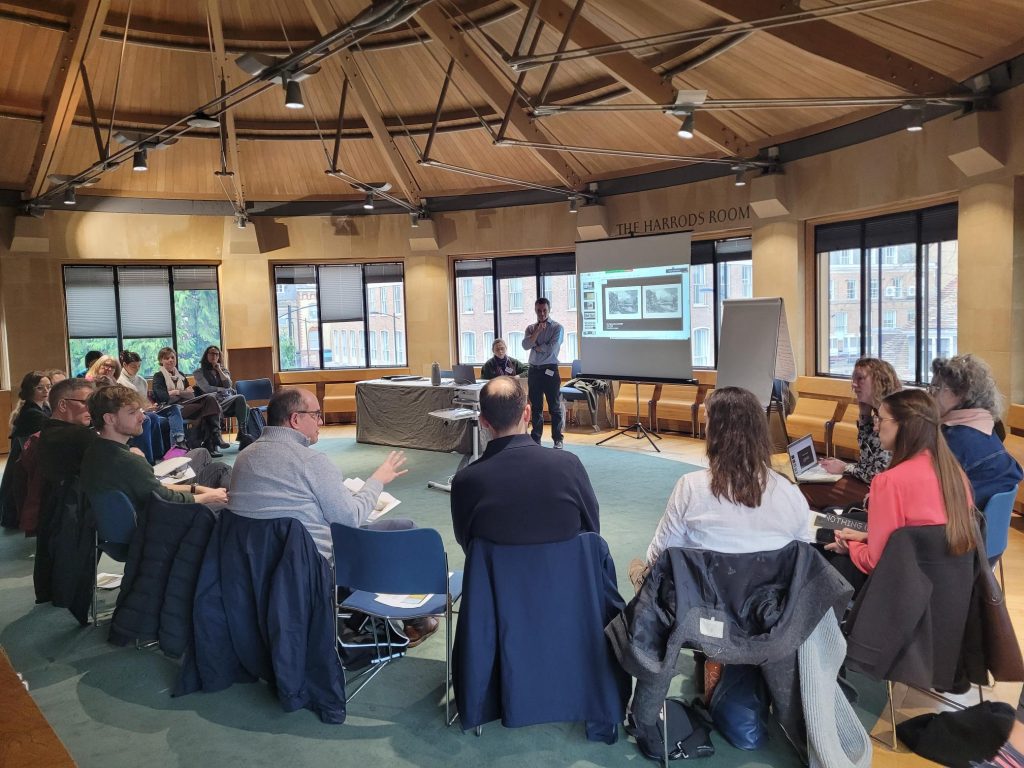
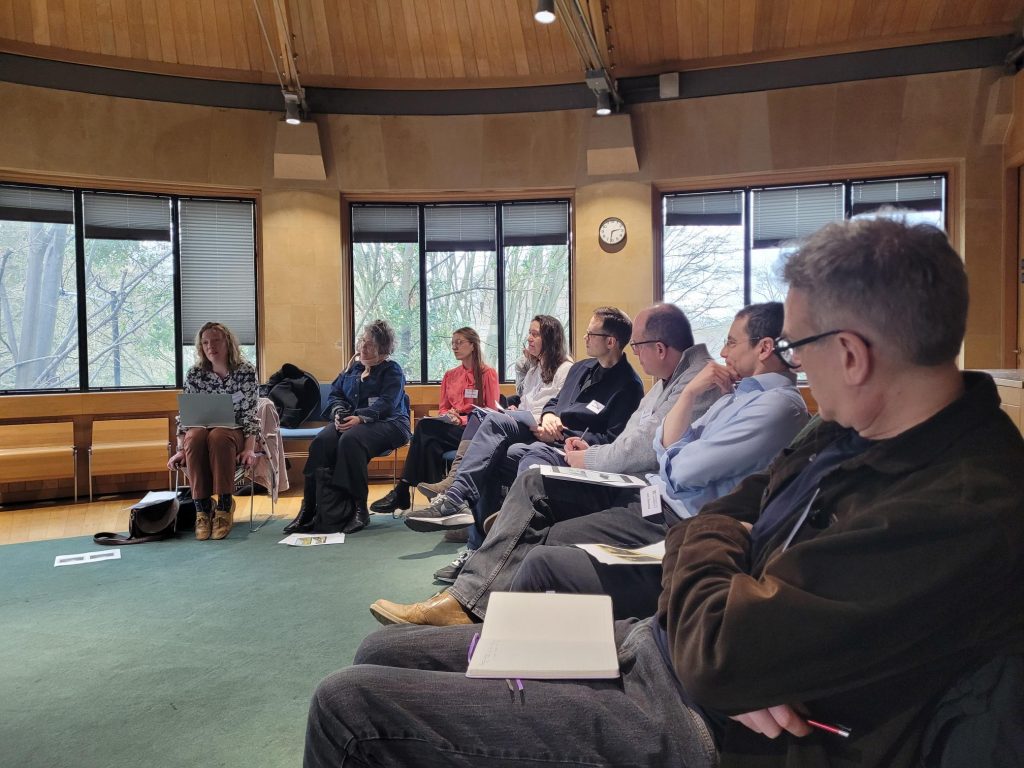
The ninth meeting of Memory Club took place on Thursday, 26 February 2026, with the theme “Memory Vividness and Art”. The session explored how the vividness of a memory relates to its accuracy, and how artistic practice can both illuminate and complicate that relationship.
?
Photograph © Martha McGill.
Our first speaker, Professor Dan Schacter (Harvard University), opened with a talk inspired by paintings from his memory-focused art collection and by the work of Franco Magnani. Magnani, born in Pontito, Italy, in 1934, emigrated to the United States in the 1950s and settled in San Francisco in 1965. After a period of personal crisis and intense dreaming about his childhood village, he taught himself to paint and devoted his life to producing detailed “memory paintings” of Pontito.
Professor Schacter showed how, when Magnani’s paintings were compared with the actual village decades later, they proved remarkably faithful: not exact reproductions, but close and consistent depictions with only minor inconsistencies.
He also shared his personal recollections of meeting Magnani and described how compelling the painter’s accounts of Pontito were.
?
Video depicting Franco Magnani’s paintings.
Professor Schacter then turned to flashbulb memories, which are vivid recollections of the circumstances in which people learned about major public events. Although the “now‑print” flashbulb idea suggests these memories are fixed, later research shows they remain vulnerable to distortion over time and to influence from media and other sources. Schacter discussed collaborative work examining these effects and highlighted how artists have engaged with the phenomenon. For example, Anne Turyn paired newspaper headlines with everyday objects to probe how context shapes the memory of an event. We also heard about several artists whose work interrogates personal and collective memory:
- Melinda Stickney‑Gibson: Her piece “Story #2” (1993) addresses a traumatic memory of a fire in the artist’s apartment. She captured the colour and sensory intensity of the fire in that memory in paint.
- Cheryl Warrick: Visible Past (1991) depicts an intrusive visual memory of abstract shapes following the birth of her first child. She then realised they were the baby rattles she was exposed to everyday, taking care of her child.
- Carl Beam: The Native Canadian artist’s series Remembering is Sometimes Quite Difficult to Do (1992) brings to mind the erosion of collective memory.
- Anita Jung: Jung’s work “Not Then, Now #2” (1990) invites viewers to reflect on memory by incorporating textual fragments that act as prompts, nudging the viewer toward the act of remembering and the instability of recollection.
More detail on these paintings can be found in Professor Dan Schacter’s book Searching for Memory.
The talk generated lively discussion about the unique ways artists translate memory into visual form, and what this can tell us about the psychological processes underlying our memory abilities.
The next speaker was Elenor Ling, Senior Curator of Prints & Drawings at the Fitzwilliam Museum, who spoke about John Constable and the museum’s plan for a major Constable exhibition set to open in October 2027.
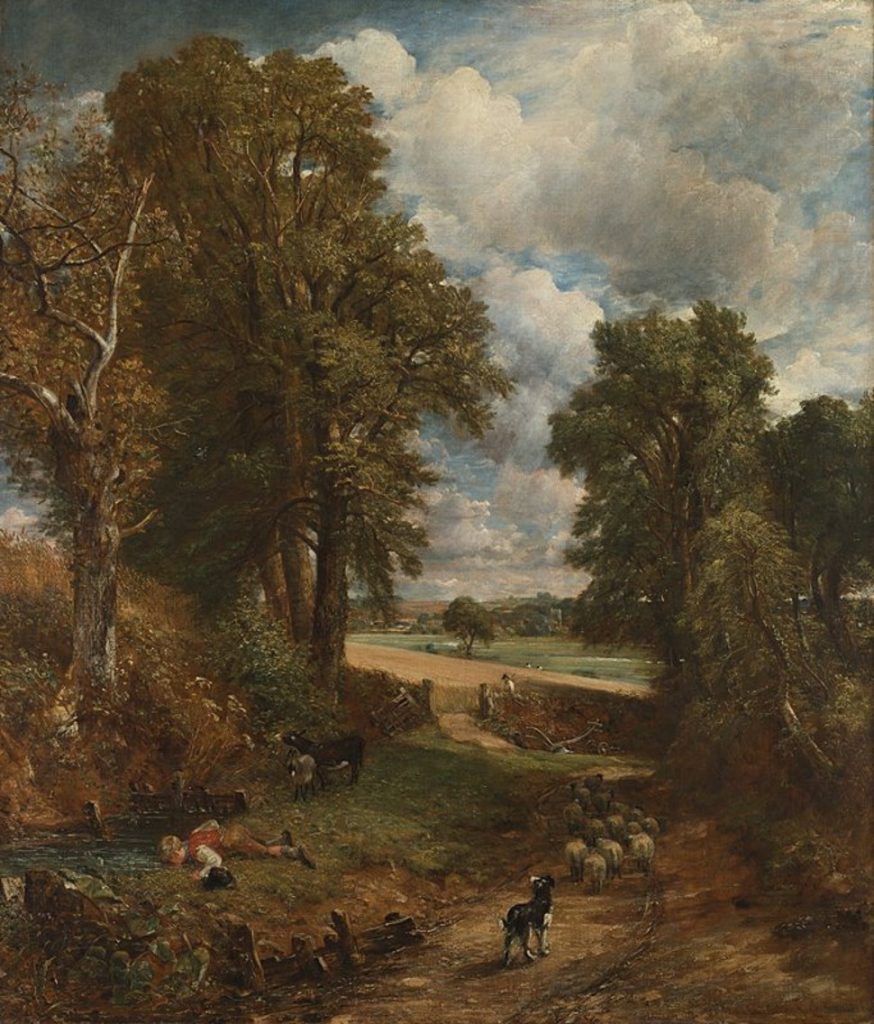
Constable (born 1776 in East Bergholt, Suffolk) struggled to gain recognition early in his career, because he devoted himself to the modest, agricultural landscapes of East Anglia rather than the dramatic, mountainous scenes then favoured by many collectors and critics at the time. Elenor highlighted The Cornfield as an example of a work Constable regarded highly and as redolent of his commitment to local landscape.
Elenor then turned to Constable’s engagement with printmaking in the early 1830s, when he sought to disseminate his images more widely through reproductive prints. He decided to use mezzotint, which was a tonal, dark‑to‑light technique that required the plate to be roughened to hold ink and then selectively scraped and burnished to create lighter areas. Constable collaborated with a young print-maker called David Lucas to produce mezzotint impressions after his paintings.
?
John Constable. The Cornfield (1826). Oil on canvas. National Gallery, London
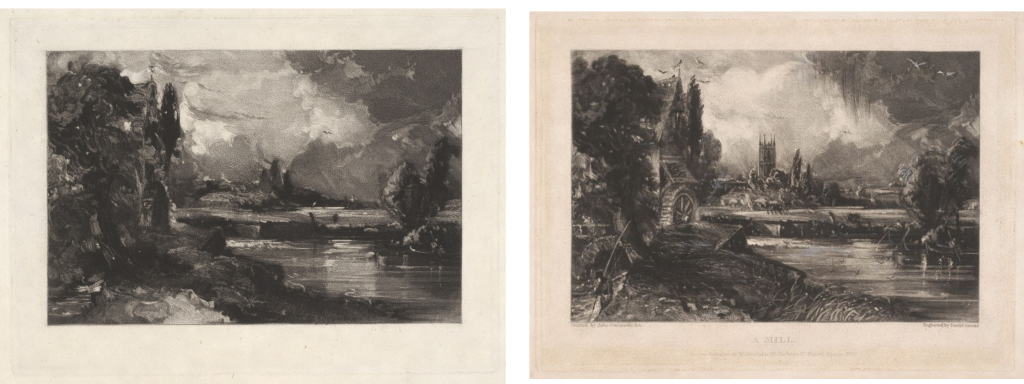
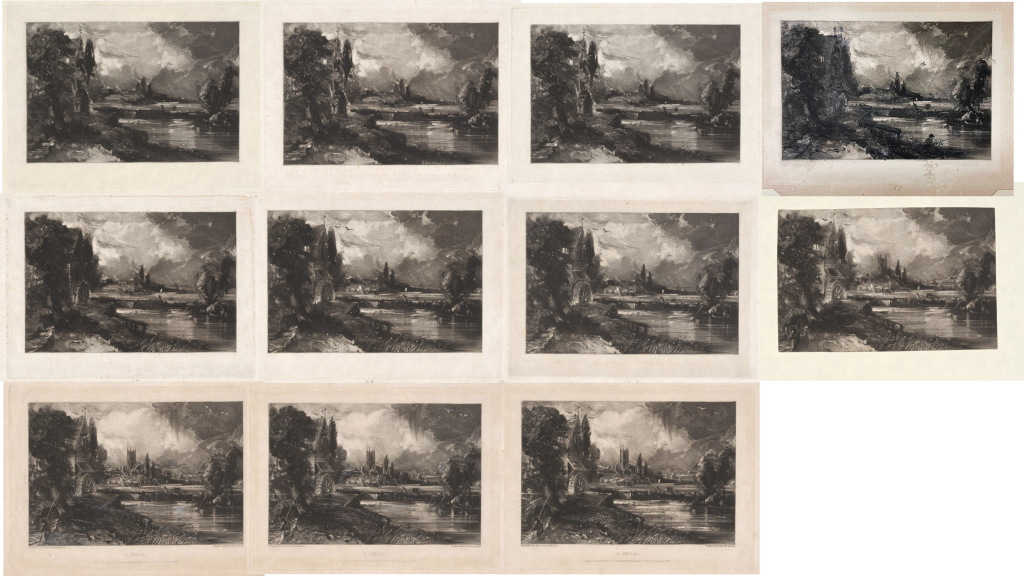
Elenor gave an example of a pair of mezzotint impressions of ‘A Mill’ (c. 1829–1832). The two impressions show notable compositional changes: the church, for example, is obscured in the earlier view but becomes more central in the later impression. These variations demonstrate how reproductive prints could evolve over time.
?
John Constable. Two impressions of ‘A Mill’ (1829, 1832). Mezzotints on paper
?
John Constable. Evolution of ‘A Mill’ (1829-32). Mezzotints on paper
Our next speaker was Bettina Varwig, a Professor of Music History at Cambridge University. In her exploration of memory in early modern music culture, Professor Bettina Varwig argued that musicians of the period understood memory not as a purely cognitive function but as a profoundly corporeal one. Drawing on vivid aural, kinaesthetic, and tactile recollections familiar to performers, she showed that early modern thinkers believed musical memory was formed through imprints left on the body. Influenced by Descartes’ notion of spirits flowing through the body’s channels, memory arose when these flows were reactivated. Therefore, to remember music was to reopen pathways inscribed through repetition. For musicians, this meant that the heart, throat, fingers, and breath were all sites of memory, not just the brain.
This embodied view shaped devotional practice. Hymn sheets served as external memory aids, but early modern worshippers relied on the engrained channels in their bodies. Their voices and fingers that “knew what to do” because tunes had been repeatedly inscribed in their flesh. Singing allowed believers to re-access emotional and spiritual imprints on the heart, the period’s recognised seat of memory and affect.
Varwig shows that this procedural, bodily memory also underpinned musical improvisation and performance. Rather than inventing from scratch, musicians elaborated on gestures their limbs already knew, revealing a musical culture in which remembering, feeling, and moving were inseparable.
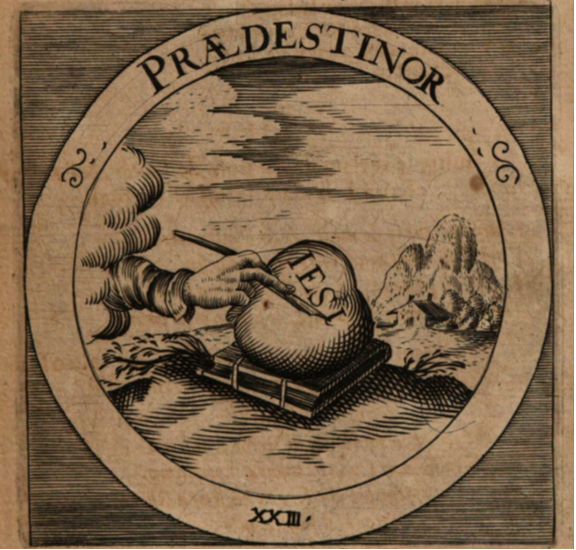
"Experience shows that through frequent repetition of the biblical words in motets, concertos, oratorios and arias, as well as through the expression or representation of devout and beneficial affections of the soul, God’s Word is implanted deeply into people’s hearts with greater force and desire. (Christoph Raupach, 1717)
?
Daniel Cramer, Emblemata sacra (1624). Public domain.
Our last speaker was Doug Chalmers, Master of Emmanuel College, University of Cambridge. Doug talked about his memories from his time as a soldier in the British Army. He described combat memories as intensely physical and multisensory. When a memory is “poked”, voices crackle over radios, shockwaves and acoustic pressure return, and smells reappear. He talked about the impact of shockwaves caused by explosions on the wellbeing of soldiers, which we are only beginning to understand in terms of their long-term consequences for cognition and traumatic brain injury (TBI) in veterans. Doug mentioned that the understanding of PTSD has improved significantly since the approaches he experienced in the 1980s, which were more limited at the time. Importantly, he pointed out that PTSD may not appear immediately and can take time to develop.
Finally, Doug talked about the importance of memory in combat and in later testimonies. Soldiers are trained to improve their memory, for example, by using games such as Kim’s Game. Current advances in military technology also affect memory: with the developments in radio technology, conversations began being taped to act as memory prompts. Later, cameras, and now drone footage provide an enormous amount of data from the battlefield to support future recollection of events.