The sixth meeting of Memory Club took place on 16 October 2025 in Durham, with the support of the Institute of Medieval and Early Modern Studies (IMEMS).

?
Photograph © Martha McGill.
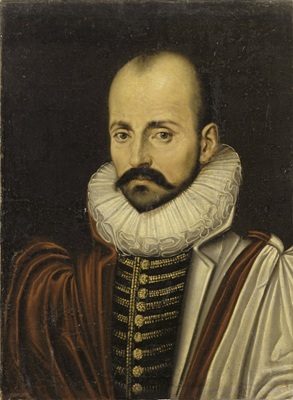
In the first talk, Kathryn Banks presented an extract by Michel de Montaigne (1533-92). Montaigne’s essays were ruminations on different topics, often built up over time, revealing and shaping his thought processes. He offered various reflections on memory as a faculty – complaining, for instance, that his own memory was ‘leaky’, and comparing memory unfavourably to judgement. However, he rarely dwelled in detail on autobiographical memories. Kathryn discussed a notable exception: Montaigne’s description of a near-death experience in which he was knocked from his horse. He initially forgot what had happened, only to find the memory returning vividly a day after the accident. His retellings of the event combine personal experience with the perceptions of others:
…a big strong fellow, on a powerful farm-horse … managed to ride it full pelt right into my path and bear down like a colossus upon the little man and little horse, striking him like a thunderbolt with all his roughness and weight, sending both of us head over heels. So there was my horse thrown down and lying stunned, and me, ten or twelve yards beyond, dead…
?
Montaigne, Essais (1580), vol. 2, ch. 6, trans. Kathryn Banks.
?
Portrait of Michel de Montaigne (1570s), Wikimedia Commons, Public Domain.
In this passage Montaigne shifts between a first-person and a third-person perspective, demonstrating how memories are socially constructed and can be viewed from multiple vantage points simultaneously.
Subsequent discussion explored how Montaigne uses imagery to convey the intensity of his experience; the tendency for people to adopt ‘observer perspectives’ during near-death experiences; and the literary practice of quoting and referencing others’ descriptions of similar events, which shows how memories are inflected by cultural heritage.
?
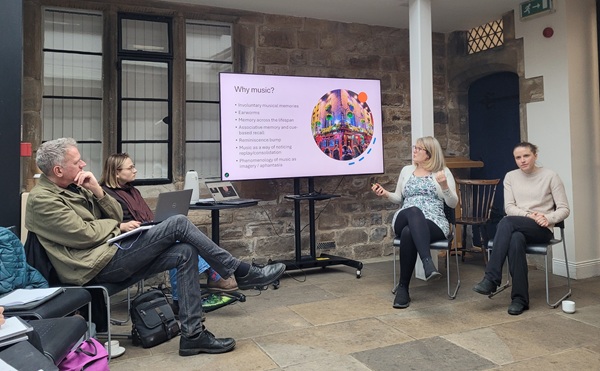
Photograph © Martha McGill.
The second talk, by Kelly Jakubowski and Catherine Loveday, examined music and memory. People can recognise music from very limited information – a half-second clip of a famous song or composition is often enough. You can test this theory by seeing whether you can identify any of the brief clips below. Click the question mark to view the answer. (Note: we’ve used copyright-free clips. Some famous orchestral pieces are performed here on the piano.)
?
Beethoven, Für Elise.
?
Tchaikovsky, Swan Lake (swan theme).
?
Rossini, William Tell Overture finale.
?
Mozart, Rondo Alla Turca.
?
Puccini, O Mio Babbino Caro.
?
Beethoven, Symphony No. 9, Ode to Joy.
?
Mozart, Eine Kleine Nachtmusik.
?
Bizet, Carmen, Habanera.
?
Debussy, Clair de Lune.
?
Bizet, Carmen, overture.
?
Beethoven, Symphony No. 5.
?
Vivaldi, Four Seasons, Spring.
?
Clips from Pixabay.
Humans also commonly have involuntary music memories, or ‘earworms’ – that is, songs stuck in our heads. This is a process of memory reconsolidation that operates ‘audibly’, if only within our minds. Music is so memorable in part because of its multidimensional forms of stimulus – we encode information about pitch, rhythm, timbre and volume. Music is often also multimodal: we may associate it with movement, and perhaps visual elements. Our memory for music varies with age, though: we remember more music as adolescents, and also remember more music from adolescence over the course of our lifespan.
Research studies on how music cues memories have been inconclusive. Some suggest that music is a particularly effective means of evoking memories. Others dispute this claim. But music does seem to evoke more positive memories than other forms of cuing. In the discussion that followed Kelly and Catherine’s presentation, we considered how music activates reward pathways in the brain, enhancing learning and perhaps colouring the emotionality of memories.
We are grateful to IMEMS for facilitating this very thought-provoking meeting.
?
Photograph © Will Duckett.