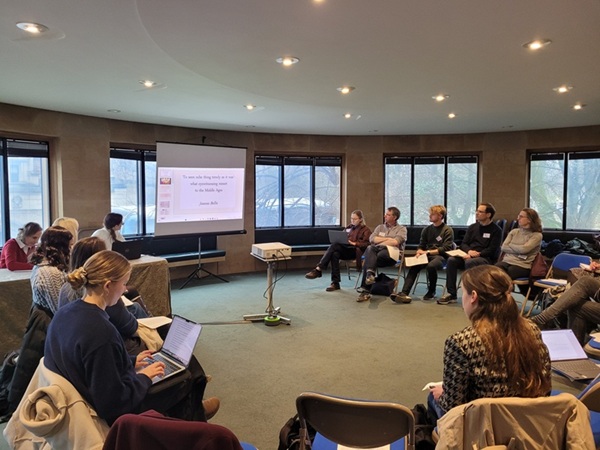
The eighth meeting of Memory Club took place on Thursday 22 January 2026. The theme was eyewitness testimony. This phrase is typically used when people are reporting crimes, or sometimes with reference to journalism. In both cases, accuracy is a central concern. But memory remains collaborative and moulded by context. Our discussions explored how testimonial truth has been conceptualised historically.
?
Photograph © Martha McGill.
The first talk was by Joanna Bellis, who is currently preparing a book on eyewitness testimony and verisimilitude in the Middle Ages. She explored how medieval culture framed seeing as a form of knowing. This association was embedded in the etymology of ‘witness’: the Middle English ‘witen’ meant ‘to know’. ‘History’, too, has an etymological link to sight: ‘witness’ is one meaning of the ancient Greek ‘histōr’. The classical and Christian traditions relied on the dependability of eyewitness testimony, and chronicles commonly fashioned reported eyewitness accounts into ‘remembrances’ to be passed down over generations. Some – such as Jordan Fantosme’s chronicle of c. 1174 – explicitly framed this remembering as a renewed process of witnessing, using the vocative case to command the reader or listener to ‘see’ the events described.
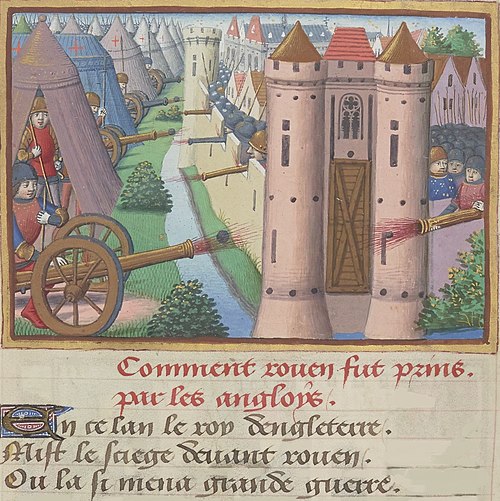
From a modern perspective there can be tension between the alleged authenticity of eyewitness testimony and the derivative imagery employed in many chronicles and poems. John Page’s eyewitness account of Henry V’s 1417-18 siege of Rouen falls back on predictable tropes. Scenes of suffering and wellbeing recall diptychs of heaven and hell; details about babies suckling dead mothers echo other accounts of conflict. In the Middle Ages, there was an expectation that experience should generally conform to recognised templates, so formulaic descriptions might carry as much or more weight than markedly idiosyncratic accounts.
?
Wikimedia Commons, Public Domain.
A miniature from a c. 1484 manuscript depicting the Siege of Rouen.
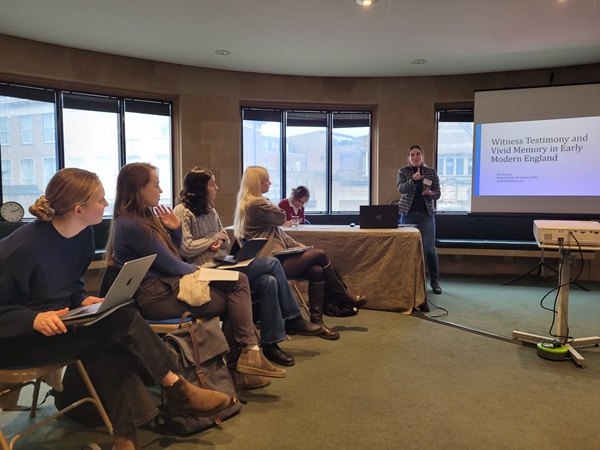
The next talk was by Memory Club member Zoe Jackson, who works on memory and perjury in seventeenth-century English courts. Early modern England was a litigious society, and witness testimony was important, particularly in criminal cases. Zoe discussed a 1678 case of alleged assault against the Harrison family. Ann and her daughter Hannah Harrison testified that they had been ambushed and attacked. Both used sensory details to make the memories vivid and convincing, but since Ann Harrison was blind, her testimony emphasised sounds and bodily experiences over visual features – an interesting broadening of our understanding of ‘eyewitness’. Other cases reflect the contemporary recognition that memory, although integral to the legal process, was not infallible. Witnesses deployed phrases such as ‘to the best of my remembrance’, and the vagaries of memory sometimes became a defence in perjury cases.
?
Photograph © Martha McGill.
The second half of the meeting was devoted to close reading and discussion of a 1643 deposition by a woman called Elizabeth Price. Price described her own imprisonment, and the persecution of other Protestants, during the Irish Rebellion of 1641. The Church of Ireland gathered some 3,400 depositions in the early 1640s and 1650s, documenting the sectarian violence as a preliminary step towards pursuing justice and reparations. Deponents gave oral evidence that was recorded by scribes. Pre-set questions shaped the testimony, and doubtless also the memories underpinning it.
?
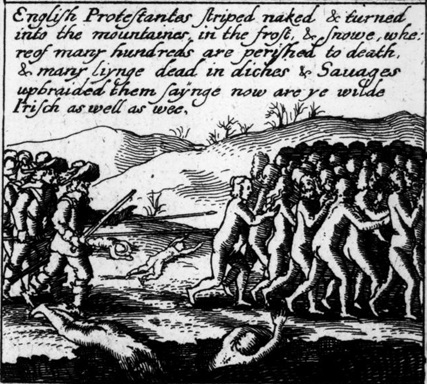
The Teares of Ireland (London, 1642), 23 (image), cover (quotation below). Internet Archive, Public Domain.
An etching illustrating a 1642 pamphlet about the Irish Rebellion. The pamphlet sought to catalogue the ‘unheard off cruelties and perfidious treacheries of blood-thirsty Jesuits and the popish faction … to animate the spirits of Protestants against such bloody villains’.
Other contextual factors further influenced the depositions. In the years between the rebellion and the process of testifying, discussion within communities and the narratives popularised by pamphlets and woodcuts crystallised particular scenes as collective memories. Tropes of Protestant victimhood, such as the St Bartholomew’s Day massacre, may also have affected how people recalled and interpreted their experiences. The depositions exhibit a mixture of personal memory and hearsay. There is evidence of selective forgetting, and there is a persistent emphasis on victimhood rather than on perpetrators: deponents described atrocities in detail, but often hesitated to name the individuals responsible.
While this suggests some uncertainty about the prospects of obtaining terrestrial justice in a period of ongoing upheaval, the depositions reveal a collective interest in the spiritual significance of the conflict. There are various stories about ‘providences’, or remarkable events orchestrated by God. Price recounts seeing a ghost with twinkling eyes and ‘skinn as white as snowe’ who called for revenge. Since ghosts could appear only by divine permission, there was an implication that God supported the Protestant cause. Pamphlets further stoked the religious divide, seeking to stir up Protestant outrage. Stories about the rebellion were invoked at moments of heightened anti-Catholic sentiment into the eighteenth century and beyond.
Price’s deposition paints a rich and compelling picture of persecution. But it seems likely that some of the details she provided stemmed from collective rather than personal memory, and were shaped by these narratives of victimhood and religious warfare. Psychologists now recognise that traumatic memories are often fragmentary and focused on key details at the expense of a wider picture, which jars with Price’s comprehensive overview. Eyewitness testimony remains a valuable source of information about the past, but it is always mediated by present concerns.