The twelfth meeting of Memory Club took place in Cambridge on Thursday, 18 June. It brought together historians, psychologists, and artists to explore the theme of generational memory.
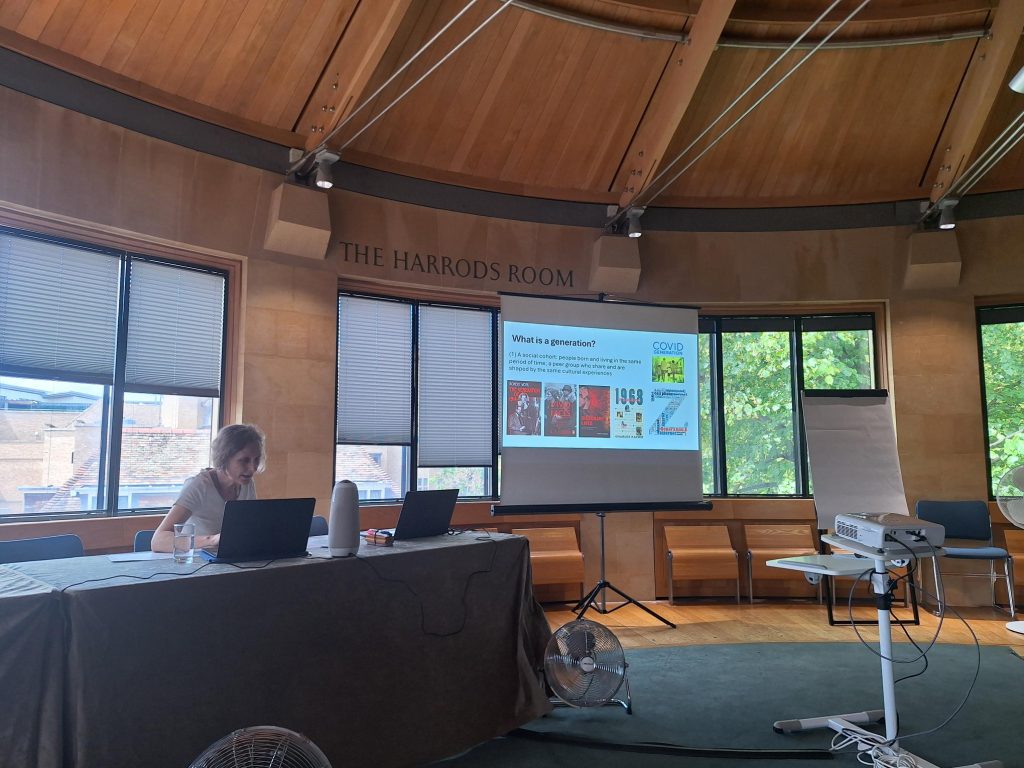
The seminar was opened with introduction by Professor Alex Walsham, who introduced the theme by unpacking the many meanings of the concept of a “generation”.
As Alex highlighted, generation is a complex and multifaceted concept. One definition understands a generation as a social cohort: a group of individuals shaped by shared cultural experiences. Another interprets generations in a genealogical sense, as links in a familial chain, extending both backwards to past ancestors and forwards to future descendants.
In the early modern period, the word “generation” carried even broader meanings. Beyond ancestry and lineage, it also referred to the act of bringing something into existence and to the reproduction of living organisms, linking it closely to ideas of family. In this sense, it also intersected with notions of race. Generations were also understood as a unit of time, the roughly thirty-year period it takes for children to grow up and have children of their own.
?
Photograph © Kasia Mojescik.
Finally, one now largely obsolete definition of “generation” describes it as a history or narration of events, which brings it closer to the definition of memory itself.
Alex introduced the influential work of cultural theorists Jan Assmann and Maurice Halbawchs, who distinguish between communicative and cultural memory. Communicative memory refers to living memory shared through conversation, storytelling, and personal experience, typically spanning 80-100 years, encompassing the period in which three generations coexist and transmit memories orally.
Cultural memory, by contrast, is formalised and institutionalised, surviving beyond living memory through texts, monuments, and artefacts, and capable of enduring for centuries or even millennia. In practice, however, the boundary between the two is often blurred.
Alex then explored how memories of the Reformation were transmitted across generations. The early modern period witnessed a fascination with genealogy, with noble and gentry families producing elaborate pedigrees, attempting to trace their lineages back to Adam and Eve.
The Reformation itself unfolded across multiple generations and left a lasting imprint on collective memory. Later Protestants looked back to sixteenth-century reformers as a heroic generation who had suffered persecution and martyrdom. Memories of religious violence and trauma became central to Protestant identity long after the events themselves had passed.
Yet remembering the Reformation was never a straightforward process. As eyewitnesses died, memories moved from communicative memory into cultural memory, often shaped by selective forgetting, reinterpretation, and pious invention.
One striking example is Rose Hickman, who, in her eighties, wrote an autobiographical account for her descendants some sixty years after her exile during the reign of the Catholic Queen Mary. Hickman portrayed herself as steadfast in her Protestant faith, insisting that she had never attended “popish masses” despite the challenges she faced. Her account illustrates how later-life recollections could reshape the past through the lens of religious conviction and family legacy.
Alex concluded by discussing the concept of nostalgia. Coined in the late seventeenth century, the term originally described a clinical condition of homesickness, relating more to a longing for place rather than time.
?
Photograph © Kasia Mojescik.
Our next speaker was Dr Aline Cordonnier (UCLouvain), who introduced the concept of family memory, distinguishing it from traditional understandings of autobiographical memory. While autobiographical memory concerns events we have personally experienced, recent psychological research has increasingly focused on vicarious memories, which are events known only through the accounts of others.
These inherited memories can be remarkably vivid. People often recount family stories with detail and emotional immediacy, despite not having witnessed the events themselves. Aline conceptualised family memory as a bridge between personal and collective memory. Family stories occupy the intersection between individual experience and wider cultural narratives, connecting what matters at a personal level to wider social and historical contexts.
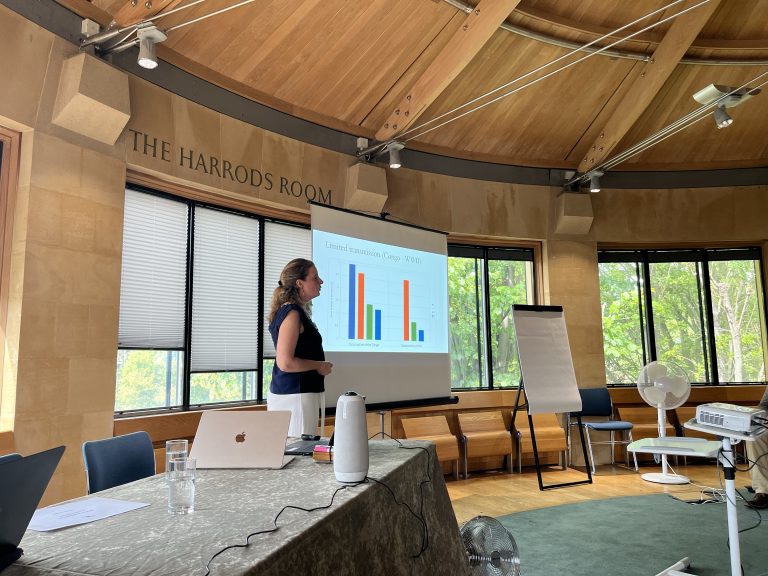
Drawing on findings from the TRANSMEMO and RE-MEMBER projects, Aline examined how memories are transmitted within families in regard to WWII and the colonial history of the Congo. She interviewed multiple generations within the same families, from those directly involved in historical events to their grandchildren and great-grandchildren. Participants were asked to recount family anecdotes in as much detail as possible.
The findings showed that memory transmission declines rapidly across generations, with a marked drop even after a single generation. However, this decline is less pronounced when the events recalled are a source of pride for the family.
Aline compared memory transmission in families connected to the colonisation of the Congo with those of families who had collaborated with the Nazi occupation during the WWII. She found that even fourth-generation descendants of those involved in the Congo retained some knowledge of these events, whereas fourth-generation descendants of collaborators often had little or no awareness of their family’s past.
In addition, different types of experiences gave rise to different kinds of stories. In families involved in the colonisation of the Congo, anecdotes often centred on themes of adventure and everyday life. Family objects brought back from Africa frequently acted as conversation starters, reinforcing narratives of exploration and personal experience rather than broader colonial structures.
By contrast, families connected to wartime collaboration often focused on the consequences of those actions rather than the events themselves. This involved anecdotes about imprisonment, social stigma, repression, and the lingering impact on descendants. Physical objects associated with collaboration, such as uniforms or photographs, were often hidden away or forgotten until later generations rediscovered them.
Aline also highlighted the importance of silence. Family memories are shaped not only by what is remembered but also by what remains unspoken. These different forms of silence can be understood as reflecting a range of constraints and choices in how family memories are transmitted. Some silences arise from a lack of access, when key individuals have died or disappeared, while others are chosen, reflecting a reluctance to revisit the past. Silence may also be imposed, where individuals are not permitted to speak, or impossible, when experiences are too difficult to articulate. In other cases, silence is shaped by social dynamics: awkward silence stems from fear of another’s reaction, while requested silence occurs when listeners prefer not to know. Protective silence helps preserve emotional well-being or relationships, whereas in some instances silence is obscured by noise, with much being said but important details left unstated. Finally, disinterested silence emerges when a story feels too distant, either from one’s own life or from the present.
Aline’s research demonstrates that collective representations influence family storytelling from the top down, while personal narratives can, in turn, shape broader collective understandings from the bottom up.
The final presentation came from artist Helen Barff, whose work explores memory through touch, materiality, and embodied experience.
?
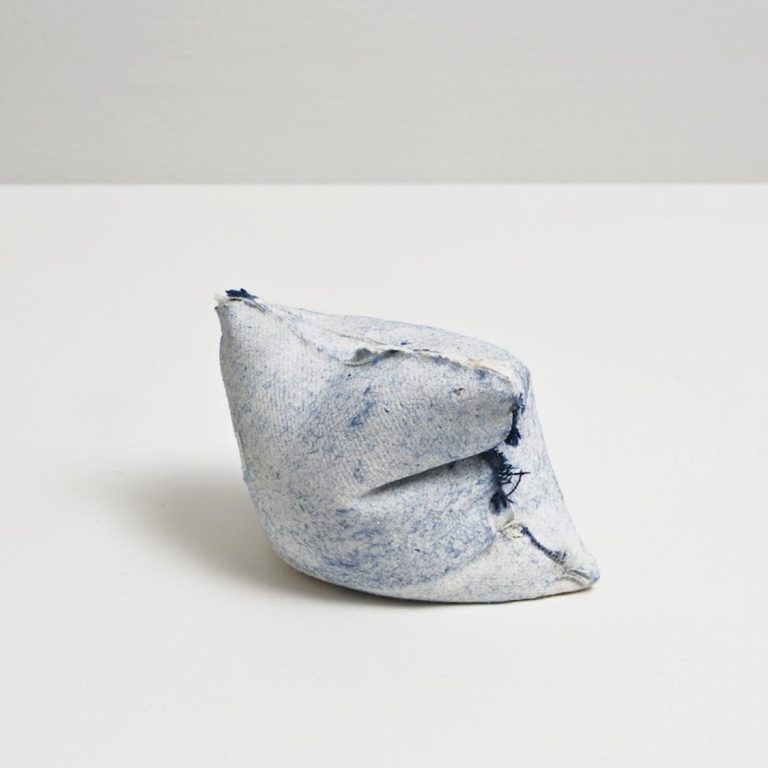
‘Pocket 28’, 2013, plaster 9.5 x 10 x 5.5cm © Helen Barff.
https://helenbarff.co.uk/
?
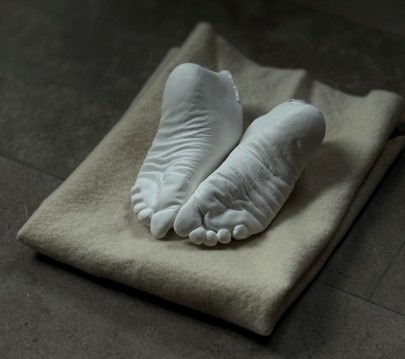
‘The Ground That Gathered Beneath My Feet’ © Helen Barff.
https://helenbarff.co.uk/
One recent project involved working with residents of a YMCA hostel who had experienced displacement. Helen created created casts of their feet, which were later exhibited in St Giles Cripplegate. The casts represented the journeys participants had undertaken. Each cast carried traces of lived experience: where people had come from, what they had endured, and where they hoped to go.
Helen also recorded interviews with participants to document their stories. She shared the story of one participant who had walked from Syria, attempted multiple sea crossings, and eventually travelled across Europe. Reflecting on the project, he remarked that despite everything his feet had carried him through, he had never really thought about them before. He later sent casts of his feet back to family members in Syria whom he had not seen in fourteen years.
The project makes one reflect about memory, belonging, and what it means to inherit displacement. Helen shared her own memory of leaving Sudan as a child, vividly remembering the moment she realised she would never return. Such memories, Helen suggested, remain embedded in the body, carried forward across generations.
Helen’s broader artistic practice investigates how objects and materials, especially clothes, hold memory.
Working with clothing, shoes, and personal possessions, she creates casts that capture intricate traces of wear and touch. In the image above, you can see a cast of her son’s pocket. We know the insides of our pockets intimately, and Helen’s aim was to transform this intimate space into a solid form. The cast preserves not only the shape, but also the colour and the texture of the clothing.
Through projects involving care home residents, including women RAF veterans with dementia, but also charity shop visitors, and community participants, she has explored how garments can become repositories of personal and collective histories.
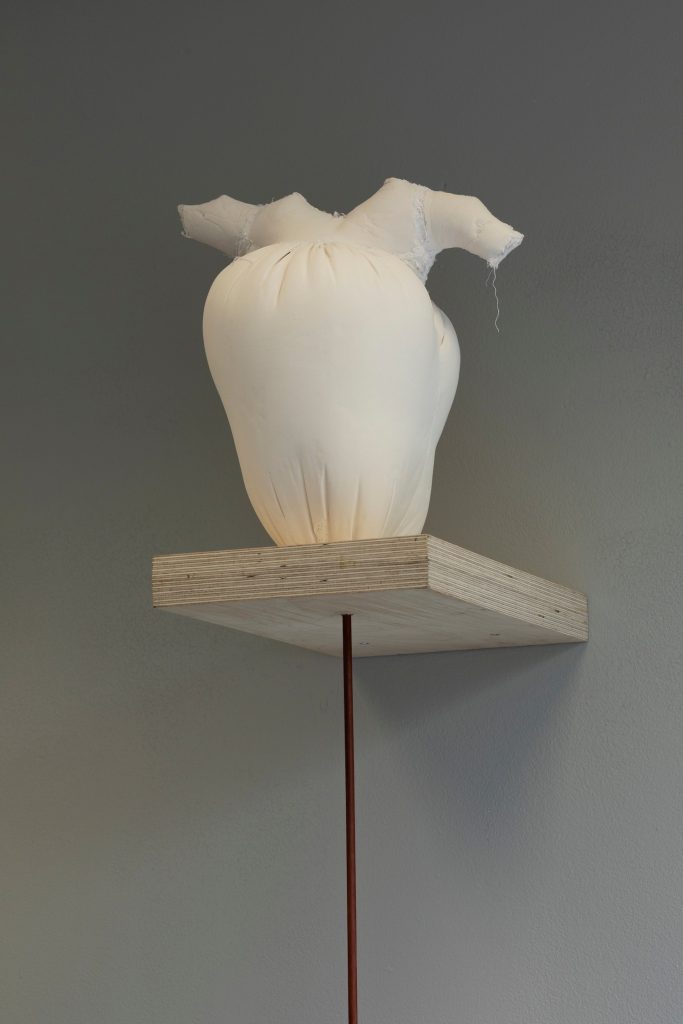
?
‘Blessed’, 2021, jesmonite, steel, wooden shelf 190 x 28 x 36cm
© Helen Barff.
https://helenbarff.co.uk/
Another project centred on inherited garments passed down through generations, including a baptism gown whose accumulated history embodied both family continuity and the weight of expectation.
Throughout her work, Helen demonstrates how memory resides not only in stories but also in the material world around us. Objects, especially pieces of clothing, become vessels through which experiences and emotions are carried forward.