The seventh meeting of Memory Club took place on Thursday 20 November 2025. This month has seen the launch of the Memory and Film Festival, organised by project member Raphael Lyne. The memory club meeting focused on the same theme.

?
Photograph © Martha McGill.
The first speaker was Joseph Bitney, who explored how cinema has portrayed memory over time. Between 1908 and 1917, silent films occasionally experimented with flashbacks. They typically relied on context and the relationship between different shots to communicate the shift to the past, rather than employing distinct cinematographic techniques. In the subsequent two decades, flashbacks were largely confined to B-movies.
This changed in the 1940s, when flashbacks entered the Hollywood mainstream. Amid the nostalgia and trauma of wartime, there was surging interest in the themes of memory and forgetting. Flashbacks were typically used to develop character psychology, but the scenes themselves played out objectively, not being impacted by the vagaries of memory or the limits of the character’s knowledge. Optical devices signalled the shift between present and past. One interesting deviation from this pattern features in The Best Years of Our Lives (1946), which portrays reminiscing without showing the actual memory by using sound, camera movement and focus on the actor’s face.
?
Public Domain film.
Fireside Reminiscences (1908) offers an early example of flashbacks, which here are projected on to a fireplace. A scene from the present is projected in the same way.
?
Clip made available by the copyright holder, Warner Bros. Entertainment.
The flashback scene from The Best Years of Our Lives (1946).
This period also saw growing interest in psychoanalysis. Films began to offer what the critic Manny Ferber dismissed as a ‘drugstore version of Freud’, exploring the largely erroneous idea that repressed or confused memories could be recovered by identifying a key trigger, or perhaps by treatments such as injections. In subsequent decades, explorations of memory began to deal in more subtle ways with the unreliability of memory. Works such as Hiroshima Mon Amour (1959) and Last Year at Marienbad (1961), both directed by Alain Resnais, overshadowed the present with an elusive, fragmented past, continually slipping beyond the grasp of both characters and viewers.
?
Public Domain film.
Shock (1946) shows injections triggering recall and lucidity.
The next talk was by the neuroscientist Amy Milton, who analysed two more recent explorations of memory within film: Memento (2000), directed by Christopher Nolan, and Eternal Sunshine of the Spotless Mind (2004), directed by Michel Gondry. Neither film offers an entirely accurate portrayal of cognitive processes, but both are grounded in psychological theory, and both successfully depict the fragility of memory.
Memento was inspired by the story of Henry Molaison (1926-2008), an American man who underwent the bilateral removal of his medial temporal lobes to treat epilepsy. The surgery was partially successful in controlling Molaison’s convulsions, but left him with anterograde amnesia, or the inability to construct new memories. Memento’s protagonist, Leonard Shelby, has the same affliction, stemming from an accident. The film is non-linear: black and white scenes depicting the past play in chronological order, intersected with colour scenes that begin in the present and work backwards. This narrative structure forces the viewers to share Leonard’s disorientation, jumping continuously into new and unmoored presents. Memento sometimes inaccurately describes Leonard’s anterograde amnesia as short-term memory loss (his short-term working memory seems unimpaired). However, the film effectively communicates the multifaceted nature of memory, as well as exploring how remembering involves various brain regions.
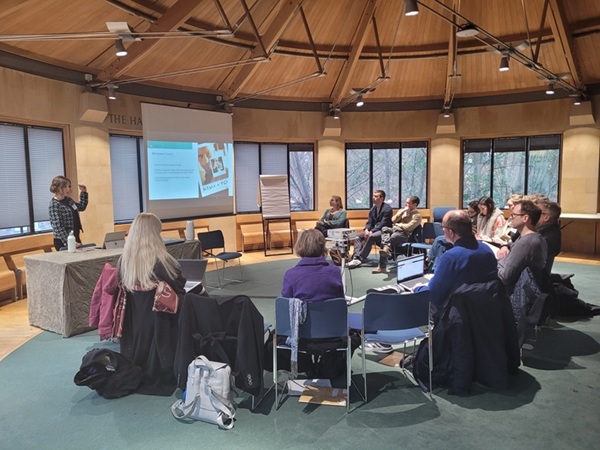
?
Photograph © Martha McGill.
Eternal Sunshine of the Spotless Mind introduces Lacuna Inc., a corporation that offers to erase unwanted memories. The process works by triggering memories, using brain scans to determine where they are stored, and then damaging the neurons to degrade the emotional core of the memory. While this vision of memory storage is over-simplified, and the technology itself is a fantasy, the film does reflect neuroscientific theories about the significance of memory activity and the importance of emotion. Actively recalled memories are temporarily unstable, and may be updated in a process known as reconsolidation. Amy’s research has explored how flashbacks of distressing visual imagery can be assuaged by playing Tetris during reconsolidation, lessening the emotional power of the memory.
The final talk was by project member Kasia Mojescik, who looked at how films can be powerful tools for studying memory. We experience life in a continuous flow, coloured by context, cognition and emotion. Laboratory memory tasks often ask participants to recall word lists or single images, which bears little relation to most of the day-to-day operations of memory. Films constitute dynamic event models that more closely resemble real-life experience.
Kasia offered various examples of experiments that have used films within their methodology. In a classic 1974 study, people watched videos of car accidents and answered questions about them. The authors found that participants who were asked how fast the cars ‘smashed’ into each other remembered higher speeds than participants who were asked about the cars ‘hitting’ each other. This shows how our memories can be influenced by the wording of questions, which is important when assessing the reliability of eyewitness testimony.
Other research has explored how people’s brains show broadly consistent patterns of activity when recalling the same videos, suggesting that humans convert experiences into memories in similar ways. Films have also been used to examine the importance of ‘event boundaries’ – beginnings or endings that signal shifts from one context to another. A 2011 study showed participants short videos and found brief bursts of activity in memory-related brain areas when an event ended. A 2023 study found that when a video stops just before an action is finished, people sometimes form a false memory of the completion of the action. If a video stops just after one scene ends and another begins, people often forget the beginning of the new scene. These studies reflect how our brains categorise our experience into discrete segments and prioritise encoding memories about goal completion.
?
The study and related materials have been made available by the authors. Petar P. Raykov, Dominika Varga and Chris M. Bird, CC BY 3.0.
An example of an incomplete video clip used in the 2023 study.
?
The study and related materials have been made available by the authors. Petar P. Raykov, Dominika Varga and Chris M. Bird, CC BY 3.0.
An example of a clip that ends just after a new scene has begun, from the 2023 study.
This was our last Memory Club meeting of 2025, but we look forward to reconvening in the new year. The Memory and Film Festival will also resume in 2026, with two film screenings and discussions planned for February.