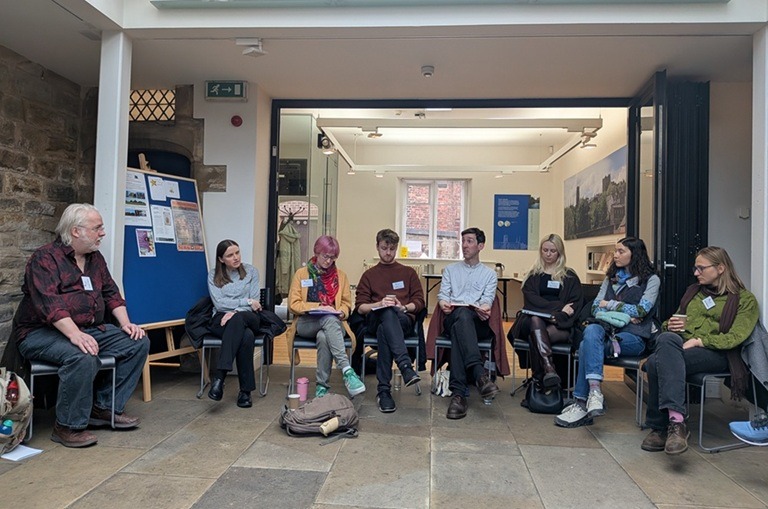
The eleventh meeting of Memory Club took place on a very wet day in Durham on Thursday 14 May, with the kind support of the Institute of Medieval and Early Modern Studies. The theme was social remembering in the early modern period.
?
Photograph © Martha McGill.
The first talk was by Andy Wood, who outlined his research on popular memory in England. He suggested that early modern memory was maintained collectively and lodged in the landscape. Different generations constructed a shared identity through oral histories and practices such as perambulations, when parishioners walked around parish bounds together.
The landscape was a palimpsest, used and reused in different ways by different cultures. Farming practices from the Middle Ages were overturned in the early modern period. The gentry made new claims to land, and processes such as fen drainage or enclosure (when previously communal land was fenced off) drew different groups into conflict over the question of how the land should be read. The summer of 1549 saw a series of popular uprisings that pitted landowners against tenants. The rebellions were defeated, but memories of them became important vehicles for community bonding and articulating a shared concept of land rights.
?
Photograph © Martha McGill.
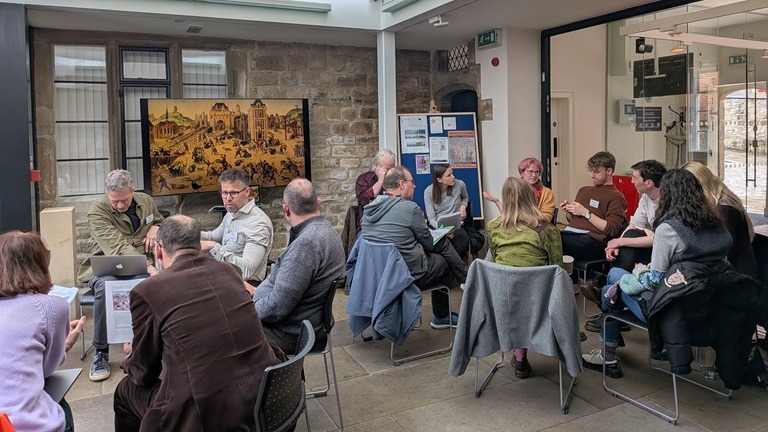
There followed a discussion led by Tom Hamilton and David van der Linden. Both work on the French Wars of Religion (1562-98), a series of civil wars punctuated by peace edicts that sought to consign the past to oblivion. Most famous was the 1598 Edict of Nantes, which called for previous acts of aggression to ‘remain obliterated and forgotten’. In practice, however, many atrocities were indelible. Tom introduced a case brought by the widow Renée Chevalier against the military captain Mathurin Delacanche in 1599. Delacanche was accused – and eventually found guilty – of multiple acts of murder, rape and robbery against the villagers under Chevalier’s protection. The case depended on a provision within the Edict of Nantes that the most ‘execrable’ cases might still be prosecuted.
The 6-month trial generated some 50,000 words. Drawing on Roman law, the court prioritised investigating witnesses’ initial perceptions, rather than later reflections. However, witnesses largely agreed with one another, raising questions about whether memories had been collectively shaped in the period following the crimes, or even moulded specifically by Chevalier in preparation for the trial. The case demonstrates the importance of law in determining the legitimacy of memory. In contrast to the conflicts explored by Andy, the case also shows how peasants and their landowner might work together, rather than battling over incompatible understandings of the past.
David noted that peace edicts did not police individual memory, only collective expressions of it. Peace was a continual and difficult process that required top-down orchestration, and memory could be a barrier to reconciliation. However, it was also an important way for communities to navigate trauma. He presented a painting of the St Bartholomew’s Day Massacre by the French Huguenot artist François Dubois. The massacre resulted in around 10,000 Protestant deaths. Having been produced in the 16th century, Dubois’ painting disappeared. It was rediscovered in the late 19th century, and became one of the defining images of the conflict. The work was a kind of memory making, setting out a story of the massacre that was legible for illiterate communities.
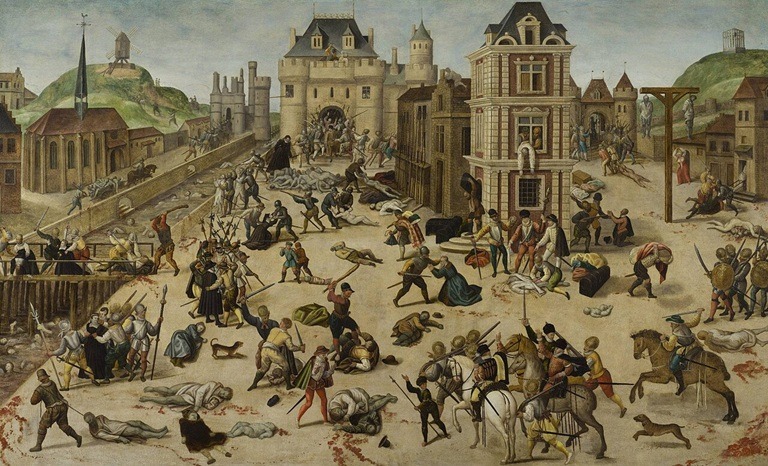
François Dubois (1529-84), St Bartholomew’s Day massacre
Following a group discussion of the court case and the painting, Kathryn Banks offered some final thoughts, reflecting on how memories of traumas are reframed after the events in question. Often this involves processes of distancing. Early modern people sometimes described their experiences by referring to other source material about different conflicts, by using rhetorical techniques such as simile, or by viewing events from observer perspectives.
Early modern peace edicts were largely blind to the effects of trauma. They were intended as a legal provision for societal stability rather than a form of psychological redress. Regardless of the dictates of governments or ruling classes, people continued to find ways to forge shared identities around the past, and continued to grapple with how to manage memories that were too potent to be repressed.
Following the meeting, Memory Club members repaired for dinner.
?
Photograph © Lewis Owens.