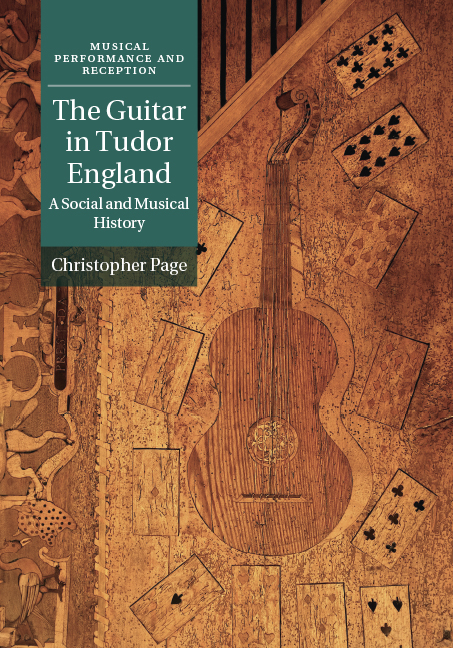
Christopher Page’s The Guitar in Tudor England: A Social and Musical History is due out this year. The title-page has just been confirmed and you can read a brief description below:
Few now remember that the guitar was popular in England during the age of Queen Elizabeth and Shakespeare, and yet it was played everywhere from the royal court to the common tavern. This groundbreaking book, the first entirely devoted to the renaissance guitar in England, deploys new literary and archival material, together with depictions in contemporary art, to explore the social and musical world of the four-course guitar among courtiers, government servants and gentlemen. Christopher Page reconstructs the trade in imported guitars coming to the wharves of London, and pieces together the printed tutor for the instrument (probably of 1569) which ranks as the only method book for the guitar to survive from the sixteenth century. Two chapters discuss the remains of music for the instrument in tablature, both the instrumental repertoire and the traditions of accompanied song, which must often be assembled from scattered fragments of information.

 Nicolette Zeeman and Jean Michel Massing have edited a fascinating collection of essays,
  [A vernicle is a ‘copy in miniature of the picture of Christ, which is supposed to have been miraculously imprinted upon a handkerchief preserved in the church of St. Peter at Rome’ (Skeat). Chaucer’s Pardoner ‘a vernycle hadde…sowed upon his cape’ (‘General Prologue’, Canterbury Tales, l.685). In this painting by Hans Memling, you can see St Veronica, who became associated with the miracle, holding the cloth.]