‘Observe temperance, chearfullnes & busynes’: notes on a manuscript miscellany
June 11th, 2026Blog; Jason Scott-WarrenA few months back, someone got in touch to say that they were the proud owner of a seventeenth-century manuscript miscellany, which had been bequeathed to them by a great-aunt. The book was sadly not a family heirloom, having been purchased from an antique dealer in the 1940s. But the owner thought that it might be interesting to the academic community and wondered if I wanted to take a look at it. And of course I did — how could I resist?
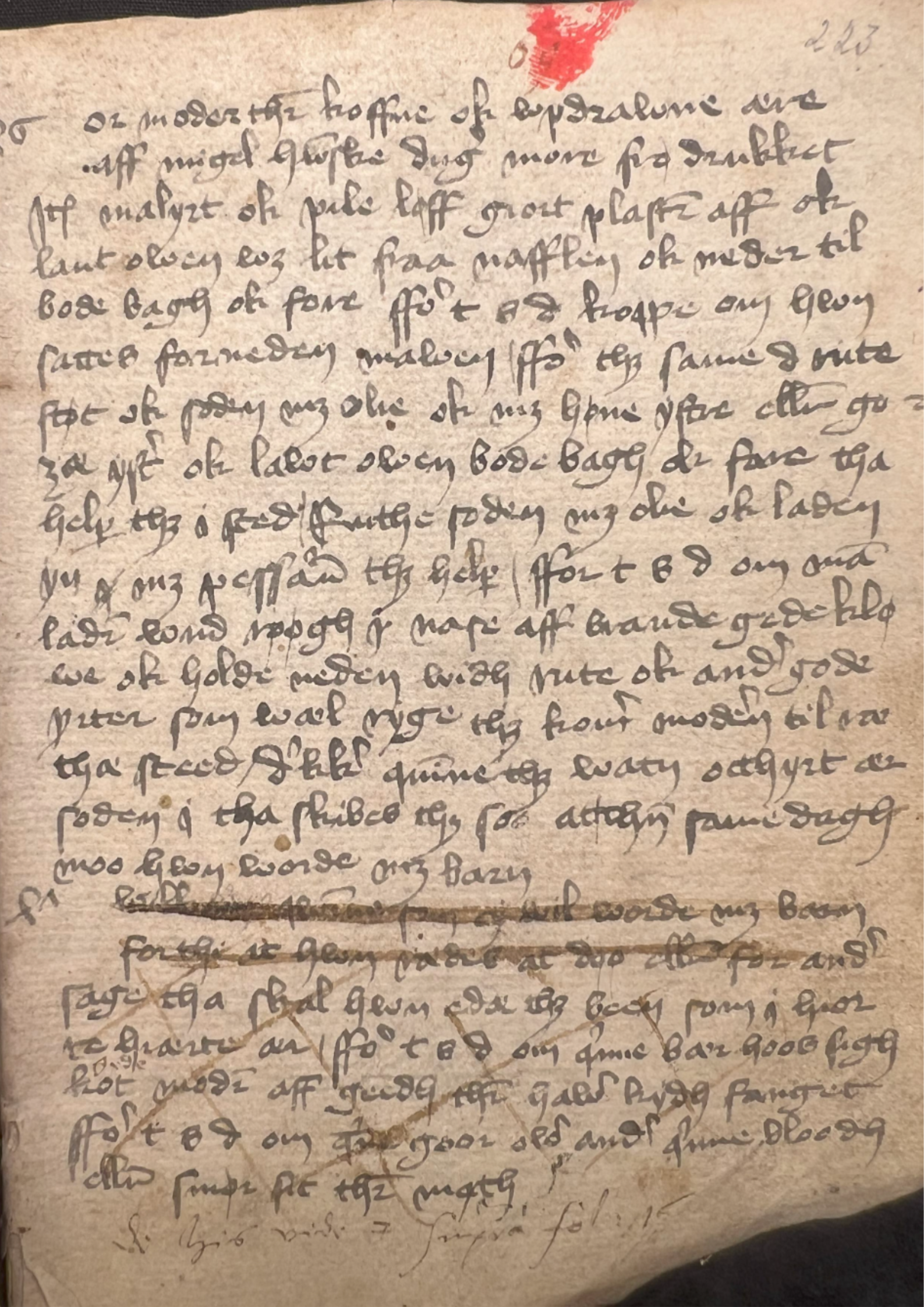
The manuscript turned out to be a small and unassuming book bound in brown calf, with blind fillets and ornaments on the boards and with seemingly original clasps still intact. It is roughly 17 cm in height and 12 cm across, with a spine that is barely 2 cm wide. Despite its diminutive size, the manuscript contains hundreds of thousands of words, thanks to the extraordinarily small and neat hand that was used by the compiler to fill its roughly 280 pages. That compiler’s name, announced in a variety of experimental signatures on the back of the first leaf, was Gregory Rouse.
We learn a little about Rouse from the very end of the volume, in a three-page biography headed ‘A breif account of Gods providentiall dealing with Greg Rouse’. Here he tells us that he was born in Suffolk in 1645, ‘of parents well Reputed’. At the age of 15 he was sent to London to take up a trade, but he hated being surrounded by ‘strang[e] faces’ and ‘strang[e] Maners so differing from the Country’, and longed to go home. Eventually, though, he decided to stay and he at last began to meet ‘come Civellized Youth’ whose company ‘wore away Countrey thoughts’; he also ‘gave way to some known sins’ for which he now seeks ‘pardon of Allmighty God’. A miraculous rescue from drowning in the Thames—when he found himself ‘very strangely taken up by the hair of the head’—was a sign of God’s care for him at this time, as was a narrow escape from being run over by a cart. But Rouse failed to give God the glory for these and other ‘deliverances’, including ‘as in the fire of London from pressing to sea &c.’ (It seems he was not keen to be drafted into the Navy). Still living dissolutely, upon his father’s death Rouse got a job as a trader in cheese, and he went back to Suffolk to live with his mother. There he rapidly ran into serious debts of £500 or more, and was ‘forced to Leave my mother friends & Countrey & wander amongst strangers in poverty Enuf’, sleeping ‘in a Wood, Church porch, & Barns’. After more than two years’ absence he returned to his mother, still penniless, throwing himself on her mercy ‘as the prodigall did’. Here he ends with a prayer to Christ that his sins ‘may not be able to Rise up against me in this LIfe to my confusion nor afterward to my Condemnation’.

The appearance and the contents of the miscellany would give one no idea that the compiler was the dissolute wretch that — doubtless under the sway of puritan modes of autobiography — he claims to be in the ‘Breif account’. To be sure, the book does give some sign of an unfixedness of purpose, since it was clearly originally designed to be a commonplace book, collecting snippets of reading under topical headings—‘Similitudes’, ‘Socinians’, ‘Antinomians’, and so on. (Some of the headings are of Biblical books—‘I. Kings. 2 Kings’; the lack of alphabetical order may indicate that the book was still unbound at this stage). That plan was clearly abandoned and the manuscript became a classic catch-all miscellany. It begins as a store of information, with a compass rose orientating you in relation to the world and informing you that Alexandria is 2169 miles away, while Athens is a mere 1624 miles. It goes on to tell you how to catch eels, wild ducks, and moles, and to offer a set of helpful rules for life (‘observe temperance, chearfullnes & busynes’). Then it turns into a repository for copious notes on Rouse’s (mostly religious) reading. These are generally transcribed without any note of their sources, though a bit of EEBO searching begins to turn up possible sources—including John Rowe’s The Saints Temptations (1675), Jeremias Drexel’s Considerations … upon Eternitie (1636); and Joseph Henshaw’s Miscellanea (1669). There are hundreds of pages of such notes, testifying to a deep engagement with books, which Rouse perhaps had to borrow and transcribe from friends, given his poverty.

And then there are the autobiographical moments, including the playful signatures at the front and the fragment of autobiography at the back. One of the most striking pages in the volume offers a set of notes made in 1665 and 1666, with marginal headings of ‘plague’ and ‘the fire’. Under the first heading we get a grisly collection of death statistics: ‘1665. till 19 of december buryed in all London & the Liberty 48569 male: 48737: feamales, in all 97306…’ Under the second we get more facts and figures: ‘1666 September 2: between 1 & 2 a Clock in the morning the fire that burnt London begun at farriners house baker in pudden Lane, & continued till the 6. consumed within the walls 373 acres of well build houses & 63 acres & 3 Rood without the walls 89 Churches burnt beside Chappells with 13200 houses, ther Remain 75 acres 3 Rood. 11 parish Churches unburnt. as appear by the surveyors account in print’. The page continues with further details of the fire and of other disasters of the same year, including one clearly moralistic observation about the edible associations of place names: ‘the fire begun in puden Lane & ended at py Corner. bad feasting at such banquets’. God’s wrath was all too legible in this succession of devastating events.
The owner of the manuscript does not want to give it to a library, but would be very happy to make it available to anyone who would like to work on it, perhaps for a graduate dissertation. The book comes with a book of notes made by the owner’s great-uncle, beginning the genealogical spadework that would need to be done to contextualise the manuscript properly. Please let me know (jes1003@cam.ac.uk) if you are interested and I can pass the message on.