
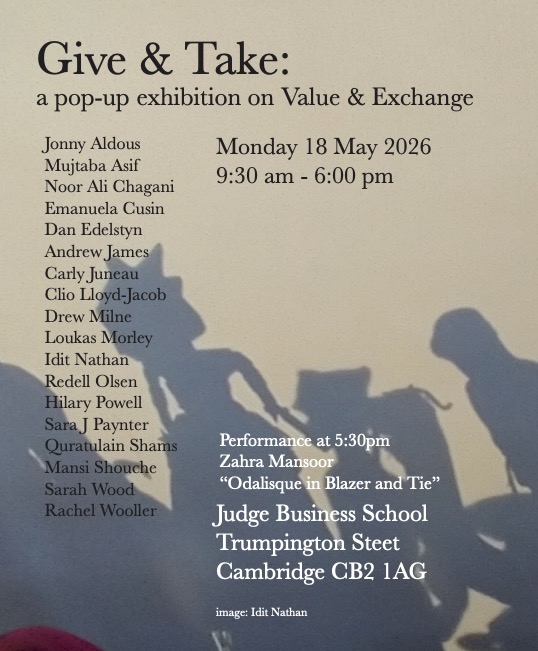
 HPC2 (How Peace Came 2), which Drew Milne made with Andrew James, is being exhibited at ‘Give & Take’, a pop-up exhibition on Value & Exchange at the Judge Business School, on Monday 18 May, 9.30am-6pm.
Here is the blurb for the artwork to be installed:
HPC2 (How Peace Came 2) by Andrew James and Drew Milne (2026).
In May 1926, the British Worker, official organ of the Trades Union Congress, announced the end of the General Strike under the headline ‘How Peace Came’. One hundred years later, how has the peace fared? How does vernacular situationism cope with the business of blurting out resistance to the regime of the bad pun? One prompt for the first iteration of the installation ‘How Peace Came’ by Andrew James and Drew Milne (London, Tannery, 1994) was the wall of dissident posters in Bejing before the Tiananmen Square protests and massacre in 1989 saw the banning of such posters. Another prompt was a lone London sandwich-board man whose board announced ‘The End is Nigh’, a gesture in turn detourned by the video game that embraces poetic oblivion. Also in play are the megaphone poster typography antics of Futurists and Vorticists, notably in Blast. Amid the derangements of digital power regimes and ubiquitous advertising commodification, what power does the dissident poster still hold? How does its noise hold up against dissident art? Some, perhaps even those who put up such posters, find the noise too deafening, and cover their ears while trying to make sense of the empire of signs. Others, perhaps even those who count themselves dissidents, will find themselves curated into indifference as artists and poets, while still scheming for quieter, if not exactly peaceful forms of resistance. Can the poster still kick back? Pssst! Wanna a badge?