An opportunity to discuss your current research with other CMT members. UL tea-room, 11am, Monday 13 March.
Jane Austen’s Sanditon – 200 Years: the history of an unfinished work
The Cambridge English Faculty is currently displaying material tracing the public life and textual forms of Sanditon, Jane Austen’s unfinished novel, which she composed in the year of her death, 1817.
The manuscript of Sanditon is held in King’s College, Cambridge, where Jane Austen’s great-nephew was Provost. This exhibition traces the public life and developing textual forms of Sanditon, from the first public reference to the work in James Edward Austen’s-Leigh’s 1871 Memoir of his aunt, through to the first published edition of Austen’s fragment (1925), the first facsimile edition (1975) and other continued, illustrated and translated editions, up to digital text. The items on display in this exhibition are on loan from Cambridge University Library and from the Gilson collection at King’s College, Cambridge.
The exhibition, to be found in the first-floor atrium of the Faculty, coincides with a conference about Sanditon to be held at Trinity College, Cambridge, 29-31 March, 2017: details, including registration information are here: https://sanditon200years.wordpress.com
CMT coffee and cake: Thursday 16 March, 10.30, in the exhibition space
The Elzeviers and their Contemporaries: Reading, Writing, and Selling Scholarship
March 9th, 2017Calls for Papers, News; Jason Scott-WarrenFriday 2 June 2017, Woburn Suite, Senate House
Institute of English Studies, School of Advanced Study, University of London
CALL FOR PAPERS
2017 marks the 400th anniversary of the death of Louis Elzevier, bookseller and founder of the publishing house which dominated Dutch printing in the seventeenth century. Elzevier books spread across the known world, through their own vast international trade network and via the many foreign students who read them while studying at Dutch universities. They thus helped shape how the topics represented were understood, learned, taught, read, collected and pirated. The renowned dynasty lives on today through the long collectability of its output and through its namesake, the Elsevier publishing house. This conference explores material evidence of the production and consumption of academic books in the early modern period, based around publications by the Elzeviers and their contemporaries.
Proposals are invited for 20-minute papers on topics related to early modern scholarly publishing. Topics for papers might include, but are not limited to:
- The contemporary book trade and the migration of books;
- The secondhand/antiquarian book trade;
- The Elzeviers in context;
- Collecting and owning early modern books;
- Piracy, both of content and publishing strategies;
- Business models of academic presses;
- Cheap publishing / pocketbooks;
- Editing in the early modern period;
- Early modern book illustration
- Relationships between authors and publishers;
- The bibliographers of publishers;
- Digitisation and metadata
The conference will coincide with a display of Senate House Library’s Elzevier collection, one of the largest worldwide.
Please send abstracts of approximately 200 words and a short paragraph of biographical information to Dr Cynthia Johnston at cynthiajohnston@sas.ac.uk by 24th April 2017.
https://www.ies.sas.ac.uk/events/conferences/elzeviers-and-their-contemporaries-conference
SCIENCE IN PRINT: UNDERSTANDING MECHANIZED BOOK PRODUCTION IN THE NINETEENTH AND TWENTIETH CENTURIES
February 5th, 2017News; Jason Scott-WarrenThe Whipple Library’s ‘Science in Print’ seminar examines the
production of printed science books from the early 1500s to the early
1900s over the course of two terms. Following on from the success of
last term’s ‘hand press’ section, we look forward this term to thinking
about mechanized book production in the nineteenth and early twentieth
centuries in a series of 3 sessions led by Drs Sarah Bull and James
Poskett on Wednesday 1, 8 and 15 March from 11.00am to 12.30pm in the
Whipple Old Library (further details below). There will be an additional
workshop at the University Library on Monday 20 March (11.00-12.30) to
look at a broader range of examples of the techniques and materials
discussed during the seminars.
The sessions are open to all (undergraduates, graduates, visitors and
beyond), but places are limited to ensure all have full access to the
examples. Please contact Anna Jones (ahr23@cam.ac.uk) to register your
interest as soon as possible. The sessions are conceived as a series,
but if you can’t manage all three, please indicate which you would like
to attend so we can allocate spaces accordingly.
_More about Science in Print II_
Understanding how a book is made and distributed is vital to the study
of its contents, helping to locate its economic and social context, its
audience, and its historical significance. Using examples from the
Whipple Library’s collection of rare books and periodicals, this
workshop series will explore some bibliographical techniques to identify
and describe the production and distribution of printed material from
the nineteenth and early twentieth centuries. Although the focus will be
on scientific texts and illustrations, these sessions will be of
interest to book historians in all disciplines, and all are welcome.
I (1 March): Review of the material structure of the book; Introduction
to 19th and early 20th century printing methods.
II (8 March): Illustration methods in the 19th and early 20th
centuries.
III (15 March): Print and technologies of distribution in the 19th and
early 20th centuries.
IV (20 March): Workshop at UL to discuss further examples.
‘Provide to be sent too morrow in the Cart some Greenfish’
February 2nd, 2017Blog; Jason Scott-Warren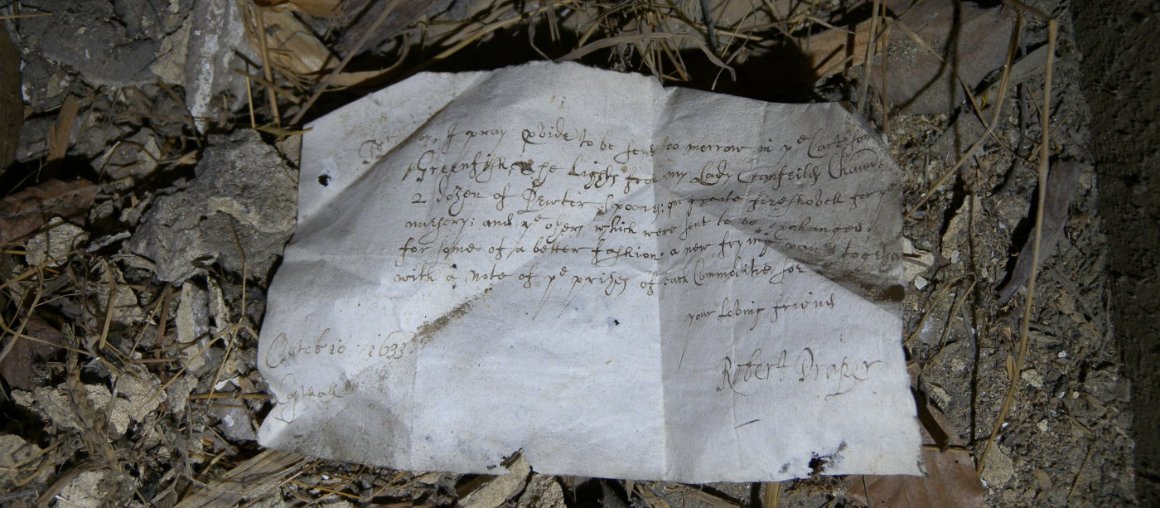 Fascinating to learn last week that three seventeenth-century letters that have been found beneath the floorboards in an attic at Knole House in Kent. The National Trust has reproduced the text of one of the letters, which asks for various goods to be brought from London to a house in Essex:
Mr Bilby, I pray p[ro]vide to be sent too morrow in ye Cart some Greenfish, The Lights from my Lady Cranfeild[es] Cham[ber] 2 dozen of Pewter spoon[es]: one greate fireshovell for ye nursery; and ye o[t]hers which were sent to be exchanged for some of a better fashion, a new frying pan together with a note of ye prises of such Commoditie for ye rest.
Your loving friend
Robert Draper
Octobre 1633
Copthall
The Trust knows exactly how this letter came to Knole, since ‘my Lady Cranfeilde’ married Richard Sackville, Earl of Dorset, in 1637, and there are documents showing that trunks full of linen, items of furniture and collections of papers were transferred from Copt Hall to Knole in the early eighteenth century.
What I like about the letter is that, both in its contents and in its later history, it is all about the transfer of stuff–the constant, pleasurable yet headache-inducing exchanges that we have with the things in our lives. I also love those ‘greenfish’. The term refers simply to fresh, unsalted fish, but one can’t help wondering whether they weren’t a bit off-colour when they arrived in the cart.
Embodying Media: From Print to the Digital
February 2nd, 2017Calls for Papers, Events; Jason Scott-WarrenCALL FOR PAPERS
Date: Saturday, 27th May 2017
Venue: Faculty of English, University of Cambridge
Within the study of media theory and history, competing narratives have identified, on the one hand, the absorption of the human voice or body within the text, and, on the other, the development of technology and material texts as extensions of that voice or body. To date these narratives have been largely located from the twentieth century onward. This one-day conference aims to readdress these narratives within a longer historical and wider interdisciplinary perspective. From eighteenth century concepts of the bodily consumption of texts by readers, and words being impressed upon their brains, to more recent imaginings of the multi-sensorial spaces of digital texts and their distribution in the new media landscape, the relationship between the media of writing and the human body has been fraught with affective potentials. This conference aims to examine this relationship between the materiality of texts and the materiality of bodies by bringing together researchers from different disciplines and time periods across the study of textuality.
Moreover, this conference seeks to make use of the potentials of such media forms for academic study. Speakers will be asked to send a digital copy of material related to their presentation ahead of the conference. These materials will be uploaded to the conference website, allowing speakers to explore the implications of their research during their presentations and enabling participants to view the material before and after the conference itself.
Possible topic areas could include:
• The physiology of reading
• The multi-sensory experience of texts: visuals, sonics, and tactility
• Literacy and the materiality of the alphabet
• The (dis)embodied nature of writing
• Technology and media and/as bodily forms of writing
• Text processing from print to the digital
• The Internet and (post)human identity
• Pens, typewriters, keyboards, touchscreens, and other media of writing
• The place of the body in media theory and history
Keynote speaker: Dr Seb Franklin (Lecturer in Contemporary Literature, King’s College London)
Please submit a title and abstract of a maximum of 300 words, along with a short biographical note of up to 50 words, to embodyingmedia@gmail.com by 20th February 2017.
History of Material Texts workshops, Lent Term 2017
January 24th, 2017Seminar Series; Jason Scott-WarrenMonday 30 January, 12.30-2
Milstein Exhibition Centre/Seminar Room, University Library
A guided tour of the Cambridge University Library exhibition ‘Curious Objects’, in the company of lead curator Jill Whitelock, followed by discussion.
Places are limited–please email jes1003 to reserve.
Monday 6 March, 12.30-2
Milstein Seminar Room, University Library
‘The Medical Book in the Nineteenth Century: From MS Casebooks to Mass Plagiarism’
A workshop led by Sarah Bull, Wellcome Trust Research Fellow, HPS
和本の形態と内容の相関関係 Formats and Contents of Japanese Books (wahon): A Meaningful Interrelation
January 20th, 2017News; Jason Scott-WarrenSpeaker: Prof Sasaki Takahiro (Keio University, Shidō bunko)
Place: Faculty of Asian and Middle Easter Studies, The University of Cambridge, Room 8-9
Date: Monday 23 January 2016, 5pm
For many centuries Japanese antiquarian materials (kotenseki 古典籍) have used five types of binding originally invented in China. The choice of one form of binding over another depended on the type of contents contained in the book alongside its purposes. Something similar happened in the case of the script, i.e. the Chinese characters and the two scripts developed from them in Japan (hiragana and katakana). Namely, the aims of a book as well as the conditions of its production determined the choice of what form of writing was used. Therefore, by studying both binding and script, we discover a meaningful interrelation between them and the contents. This type of analysis allows us to gain understanding of the genre consciousness that existed at the time as well as to determine the nature and the value of the verbal text preserved in a physical book. This lecture discusses concrete examples that will shed light on the features of Japanese antiquarian materials, which, in turn, are helpful in the study of Japanese pre-modern culture.
Notes for an exhibition in the English Faculty Building, first floor, 17 January – 17 February, 2017
Dropping his history books,
a young man, lined against the horizon
like an exclamation point with nothing to assert,
stumbles into the dance.
– “Death as History” by Jay Wright
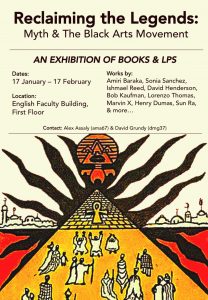 RECLAIMING THE LEGENDS: MYTH & THE BLACK ARTS MOVEMENT finds inspiration in the anti-historical world described by Wright. Its mysterious dance is the “cabinet of curiosities”: the defiance of categorical boundaries, the assembling of varied objects, the powerfully mythic rather than the historical, the rhythmic rather than the calculated. The exhibition also “plead[s]” like Wright’s dance. It asks visitors to abandon traditional epistemologies and participate in the microcosm it has created. This exhibition-world is a miscellany of anthropological & egyptological studies, revisionist histories, spiritualist & esoteric writings, books of poetry, and music record. It intimates some organizational principle, but finds time operating synchronically. Traditional chronology, here, is corrupted: Amiri Baraka, Sonia Sanchez, Lorenzo Thomas, Bob Kaufman, Ishmael Reed, David Henderson, and Marvin X appear alongside Gerald Massey, George James, and Theodore P. Ford. Like Wright’s dance, its form is ritualized and its theme is mythical.
Although the exhibition looks above and beyond “history” (“visionary-wise”), it is from there where we begin. The symbolic birth of BAM occurred in the spring of 1965. Not long after the assassination of Malcom X, LeRoi Jones [Amiri Baraka] (1934-2014) moved from Manhattan’s Lower East Side to Harlem, where he, Larry Neal and others co-organised the Black Arts Repertory Theater / School. BAM (its artists, journals, and institutions) would soon spread across a number of major American cities—Detroit, Chicago, Washington D.C., San Francisco, and New York—; however, under repressive government measures like COINTELPRO, President Nixon’s strategy of pushing Black Capitalism as a response to Black Power, and an ideological shift towards Marxism, BAM began to decline by around 1974.
Although BAM was largely a decentralized movement, its artists and thinkers did have a common political foundation: nationalism. James Edward Smethurst writes, “the common thread between nearly all the groups was a belief that African Americans were a people, a nation, entitled to (needing, really) self-determination of its own destiny” (15). BAM’s socio-political concerns bespeak of the radical significance of their historical moment. Yet, perhaps unexpectedly, “history” (as such) did not figure in the poetry and drama of BAM. In fact, many of BAM’s thinkers equated history, as Wright states, with “death.” History was the story and culture propounded by the tyrannical power of the white-West. BAM and Black Power politics wanted to change or, better, to drop “history” altogether. Neal writes, “the cultural values inherent in western history must either be radicalized or destroyed.” What was needed, Neal continues, was “a whole new system of ideas”: a system that would be alternative, black, and “mythic.”
The poetry and drama of BAM often served to build this alternative myth-world. In BAM’s literature, allusions to Akhenaten, Moses, Zipporah, warriors, gods, spirits, and orishas appear with more frequency than figures of recent history (Patrice Lumumba and Malcom X included). Symbols like the ankh or Egyptian hieroglyphs can often be seen integrated in artworks or poems. Ancient Egypt and Ethiopia regularly appear as the settings of a prosperous black past, now suppressed by white historians. If “history” distorted and oppressed, “myth” empowered. For BAM, this mythic past was also as an image of the future. Time, in the alter-world, functioned synchronically: its occupants could freely move backwards (to the glory she/he once was) or forwards (to the glory she/he will be). In infinity, as Sun Ra states “it doesn’t matter which way you go”—you will find free and everlasting life in all directions.
RECLAIMING THE LEGENDS: MYTH & THE BLACK ARTS MOVEMENT is a journey through the synchronic alter-world of BAM. The first display case (THE PAST MADE PRESENT) decides to position itself in the past. On the far left of the display case lie two books: Gerald Massey’s The Light of the World (1907) [1] and George James’s Stolen Legacy: Greek Philosophy is Stolen Egyptian Philosophy (1954) [2]. Both Massey and James’s texts reconsider the accepted history of Western tradition, concluding that a number of its philosophical and religious ideas have ancient Egyptian origins. As Massey and James’s texts assert the cultural influence of Africa, the three works in the middle of the display case encourage their readers to use this African knowledge as a means of selfempowerment. Theodore P. Ford’s God Wills the Negro (1939) [3] ends with the call to find strength in “the accumulated folk-wisdom and social experience of a hundred centuries of civilization.” Amiri Baraka, in his interview with Austin Clarke, [4] makes a similar gesture when he encourages the “black man” to repossess his ancient “lifeforce”— the force that made Egypt, Ghana, Timbuktu—and flourish as he used to. In “The Bathers” (1981) [5], Lorenzo Thomas aims to describe this life-force at work. Set in the 1963 Birmingham Civil Rights demonstrations, a young boy, hit by a high-pressure hose, “[transforms] into a lion” whose powerful “tail is vau the symbol of love.”
The most influential example of ancient myth being used as a means of self-empowerment occurs in jazz music. On the video monitor beside the first display case, the visitor can watch musical performances by Pharoah Sanders, Cecil Taylor, Archie Shepp, Albert Ayler, Sun Ra, and The Art Ensemble of Chicago as well as readings by Amiri Baraka, Nikki Giovanni, and Askia Touré. Many of the performances find their energy in ritual-like percussion or rhythmic phrasing, dance, and costume. Turning back to the first display case, the visitor sees three objects of a similar theme. Henry Dumas’s “Will the Circle Be Unbroken?” (1974) [6] tells the story of an ancient horn so powerful that it kills a group of uninitiated white listeners. In “East Fifth Street (NY)” (1965) [7], Bob Kaufman describes jazz as having the capacity to cause “time” to “[cry] out” from “the skin of an African drum.” At the very end of the first display case is Sun Ra & Henry Dumas’s The Ark and the Ankh (1966) [8]. During the course of their interview, Ra describes music as a bridge to a world beyond death, destruction, and time.
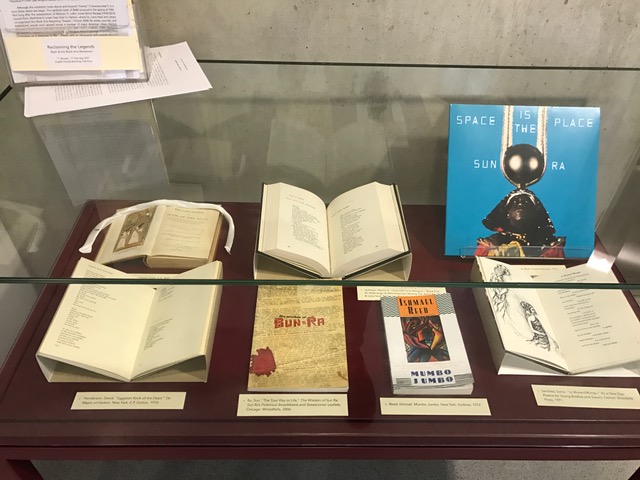
Following Ra, the exhibition’s second display case ( LOOKING AHEAD, VISIONARYWISE) positions itself in the future. On the left hand side of the display case, the visitor sees three texts that explore the theme of death bringing about new life. E.A. Wallis Budge’s translation of The Book of the Dead [1] contains a series of “magic spells” with the capacity to determine the afterlife of the deceased. In “Egyptian Book of the Dead” (1970) [2], David Henderson uses metaphors like magic spells to transform a deceased New York City into an Edenic ancient Egypt. In his ode to the legacy of Malcolm X (1968) [3], Marvin X turns Malcolm’s assassination into something affirmative, bringing with it strength, hope, blackness, and black power. While death brings about new life, myth and magic provide models of what that new life may look like. Reed’s “Neo-HooDoo” mixture of fact and fiction, history and myth, in Mumbo Jumbo (1972) [4] provides the reader with an aesthetic and cultural model antithetical to the West’s. In “The True Way to Life” (2006) [5], Sun Ra uses intuitive logic to reinterpret history, decode biblical scripture, and reveal the secret path to everlasting life. In Four Black Revolutionary Plays (1968) [6], Amiri Baraka provides examples of how sensationalism, surrealist symbolism, and mythology can be placed in the service of political protest.
The exhibition ends with two explorations of what may be called the future-present. In “to Morani/Mungu” (1971) [7], Sonia Sanchez puts “peace” in the hands of a loving mother and has her assert that it is in the present that African Americans—particularly children—can actualize their dreams. Lastly, Space is the Place (1972) [8], is a musical exploration of Sun Ra’s space world. After journeying through cacophonous horns, offkilter piano, and energetic percussion, the album ends with the electronic beeps and bops of Ra’s spaceship taking off for another voyage.
Please find two informative PDFs below. One is an extensive description of the exhibition and the objects on display and the second is a short handout visitors can pick up at the exhibition:
Reclaiming the Legends [Short]
The next event in our calendar will be a talk by Dr Nick Hardy (Munby Fellow, 2016-17), entitled ‘New evidence for the drafting, revision, and intellectual context of the King James Bible (1611)’, on Thursday 26th January.
Dr Hardy’s talk will offer the first holistic treatment of several crucial sources for the creation of the King James Bible that have been discovered or rediscovered in the years since 2011. Taken together, these sources allow us to see for the first time how an individual biblical book (the apocryphal 1 Esdras) was drafted by a group of translators, and then revised once the Bible was nearing completion. They also show how the translators’ decisions were shaped by the philological, historical and theological questions which they were asking about the origin and significance of the Old Testament Apocrypha, and their relationship to the canonical books.
The talk takes place in the Milstein Seminar Rooms at the University Library, with tea from 4.30 and the talk beginning at 5.00. Rare books and manuscripts relating to Dr Hardy’s work will be on display.