A post by Lara Harris, PhD student in the Department of Anglo-Saxon, Norse and Celtic
Cambridge, a city brimming with history and with manuscripts, is currently hosting two exhibitions that offer glimpses into the fascinating world of medieval medicine. At the University Library, the Wellcome Trust-funded project ‘Curious Cures’ displays an array of Middle English medical manuscripts (ca. 1200-1500), providing visitors with a holistic overview of medicine in late medieval England, from classical humoral theory to astrology, uroscopy, and surgery, along with numerous charms and magical remedies.
Perhaps medieval astro-physicians would have been able to foresee how the stars would align, such that another exhibition, nestling a short walk away within the English Faculty Library, would be on display at the same time. ‘Garden of Healing’, which I curated, offers an exploration of medieval medical manuscripts from almost exactly the same period (ca. 1290-1550). The main differences are that mine is focused on medieval Scandinavia, and that it solely addresses gynaecological texts.
I had the opportunity of handling, transcribing and translating a few of the manuscripts on display in ‘Curious Cures’ in a week-long summer workshop in 2023. Even back then, I was struck by the similarities between the remedies I had seen in my Scandinavian codices and those in the Middle English ones. I had not been able to trace many of these medical recipes, but the fact that they (or at least, versions of them) existed meant that I was not simply dealing with local Scandinavian knowledge, but rather a much more complex picture, where channels of communication were hazy but undeniable.
Visiting the ‘Curious Cures’ exhibition gave me the opportunity to deepen my understanding of my own medieval medical project by placing my Scandinavian remedies in a wider European context. Simultaneously, accessing the much larger Middle English corpus introduced me to an array of remedies that I had never come across in the Scandinavian material– such as a treatment for pregnancy cravings, an ailment absent in all extant Scandinavian manuscripts. But what makes this kind of research so exciting is that there are elements from the Scandinavian framework that can also clarify and put into context some of the Middle English medical texts.
Phantom Women
I was very pleased to see that ‘Curious Cures’ had dedicated a corner of the exhibition to the recognition of women in medicine as well as of texts addressed to the female body. The exhibit label explains that there are very few records that serve as evidence for women’s involvement in the practice of medicine, and that very few women owned medical books. The text goes on to explain that female medical authors are very rare, as women were banned from accessing university education, and instead they learned on the job. This is also the case in the Scandinavian realm. Out of the 36 extant medical manuscripts hailing from Scandinavia (clearly, a much thinner corpus), none can definitively be attributed to women. However, nine of them are (in)directly connected to women; and photographs from seven of these are displayed in my exhibition at the English Faculty.
Noblewomen
Two of the Scandinavian manuscripts from the turn of the sixteenth century—X 23 4to (Royal Library of Sweden) and Saml. 1a 4to (also known as Codex Grensholmensis, Linköping City Library) — belonged to Swedish noblewomen: Christina Månsdotter of the noble house Natt och Dag, and Maetta Ryningsdotter of Grensholm Castle, respectively. Both of their names are written down in the manuscripts, and in the case of Maetta, her birth date and place are added too, along with those of her children – and their star signs! It is probable that Christina’s manuscript was written specially for her, whereas Mætta’s was purchased by her family and then expanded at Grensholm. Both cases point to the fact that women (at least those of a certain status) studied and likely practiced medicine. In Mætta’s case, her interest may have been directed towards healing her immediate family and caring for her children. As for Christina, too little is known of her life to ascertain whether her pursuit of medical knowledge was simply a personal calling or whether she acted as a local or family healer.
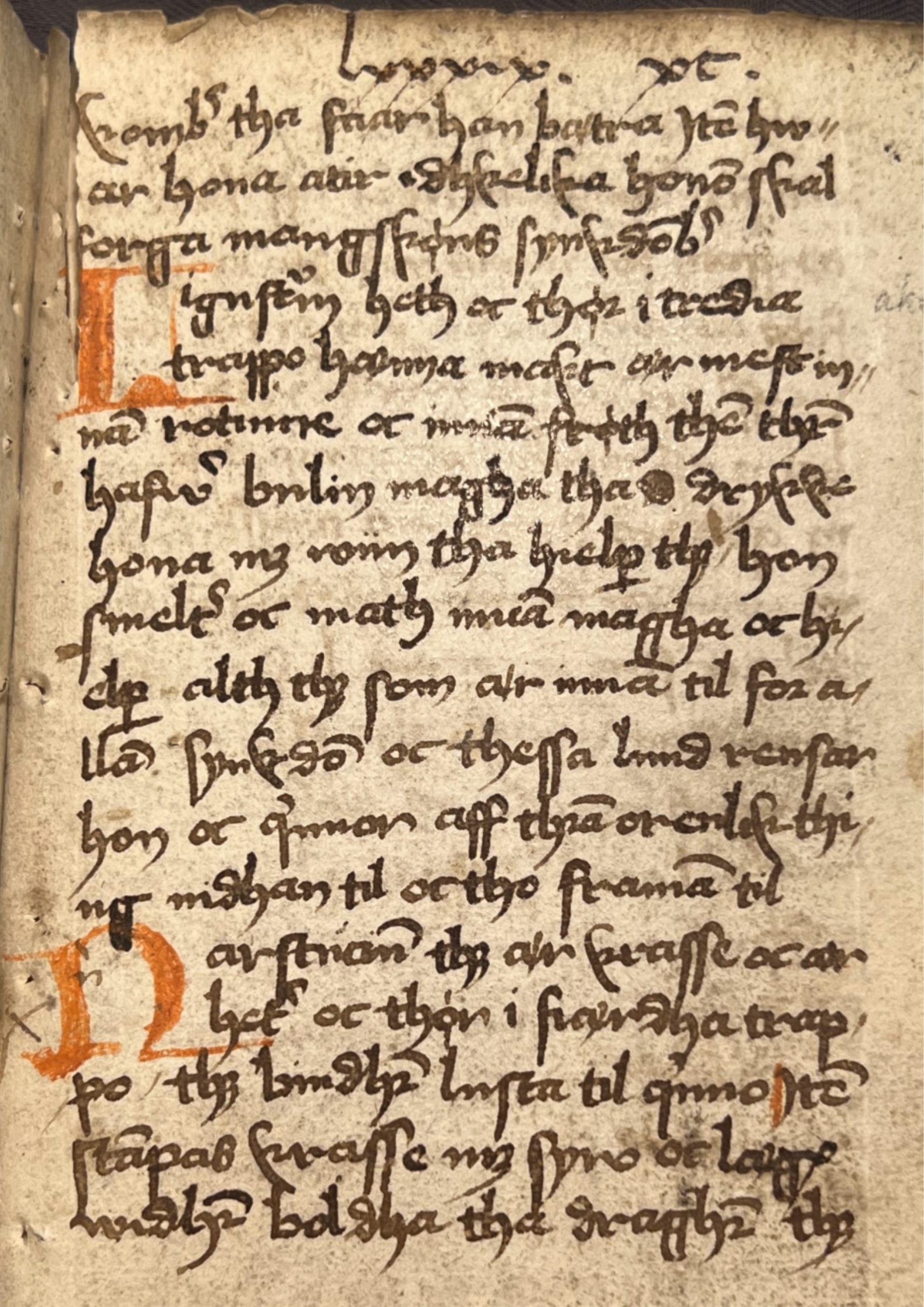
Upps. D 600, an image from the famous Danske Urtebog (‘Danish Herbal’), naming Ligustrum as a remedy for menstruation, which is called orenlik thing nidhan (‘unclean thing down below’).
The Bridgettines
Three of the manuscripts on display hail from different Bridgettine institutions across Scandinavia. The Bridgettine Order, established by St Bridget of Sweden (1303-73), was unique in that, while they were run by an abbess, its cloisters housed both monks and nuns. With royal backing and funding, each abbey was wealthy and powerful, possessing infirmaries, botanical gardens, and scriptoria.
It has generally been believed that, although the manuscripts in these cloisters were written by the monks, many were written for and/or used by the nuns; and given the long sections on gynaecology and obstetrics, it is likely that women used those manuscripts to treat themselves and pilgrims seeking medical care.
Women Authorities
The most striking example sits inside the last case of the exhibition. It consists of an unassuming manuscript with no shelfmark entitled Huskurer och Signerier på Danska (“House Cures and Charms in Danish”), dating from the second quarter of the sixteenth century. This manuscript is slightly younger than those in the ‘Curious Cures’ exhibition, which ends in 1500. However, it still falls within what is considered the Scandinavian Late Middle Ages, which is often extended to around 1550. This manuscript offers the only piece of medical text that ascribes two remedies for cancer to two distinct women: an old woman based in Halland (modern-day Sweden), and another with breast cancer in Augsburg, Germany.
Concluding Thoughts
The ‘Curious Cures’ exhibition at the University Library offers a comprehensive glimpse into late medieval English medical practices. My ‘Garden of Healing’, smaller in scale (and displaying reproductions rather than original manuscripts) focuses specifically on remedies for gynaecology and the question of female healers in medieval Scandinavia. Together, these exhibitions contribute to a deeper understanding of medieval medicine and show that women played an active part in healthcare, even if they undertook their duties in silence.
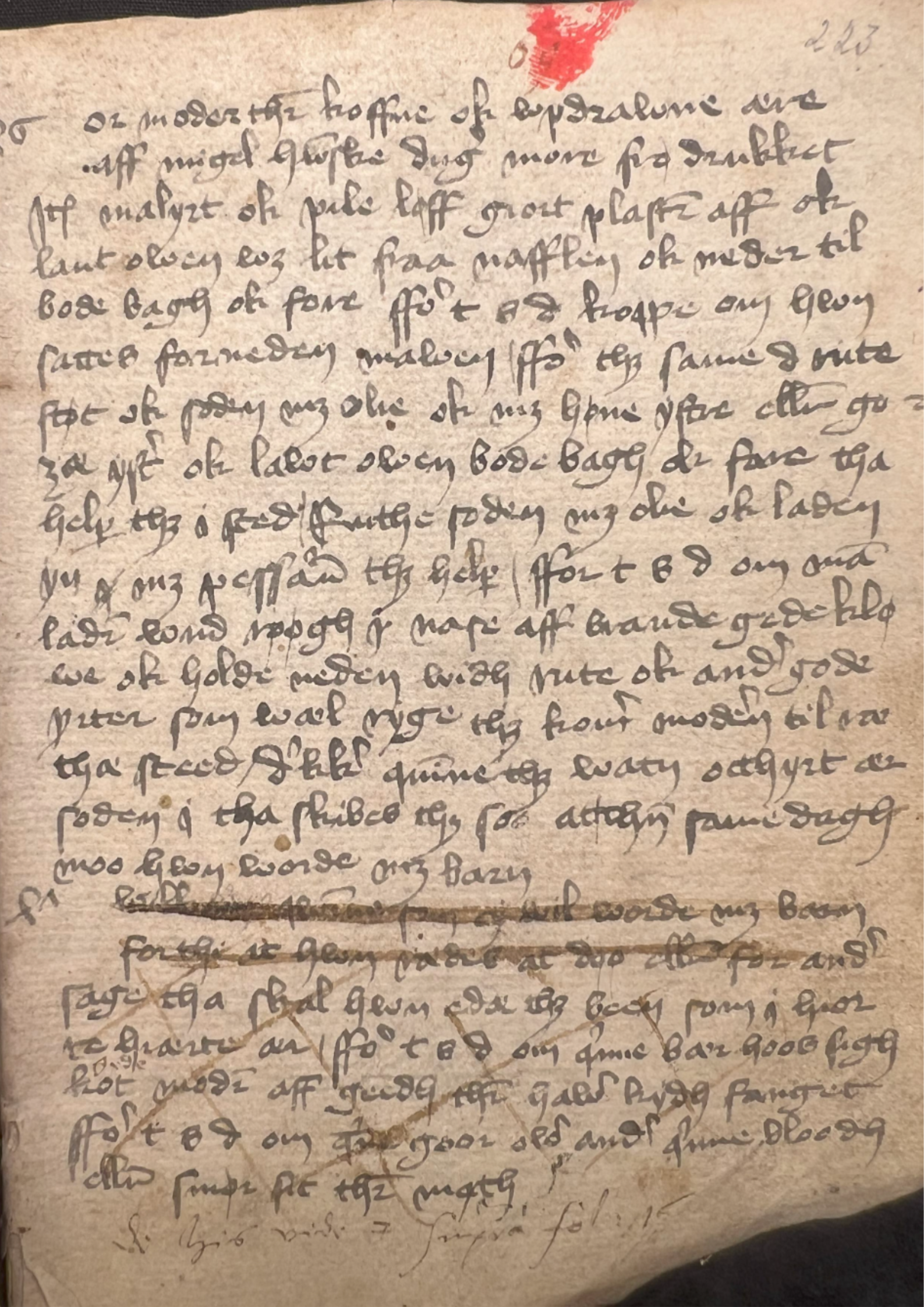
An image from Royal Library of Sweden X 23 4to, p. 223, with a crossed-out albeit still legible passage on contraception.
Back in 2019, I used this blog to raise the possibility that a copy of the First Folio of Shakespeare’s plays, held in the Free Library of Philadelphia, might bear annotations in the hand of the poet John Milton. The tantalising notes, often taking the form of tiny textual corrections and scratchy brackets in the margins, had just been analysed in detail for the first time by a scholar at Penn State, Claire M. L. Bourne, and her dating and description made it look as if a Miltonic provenance was a distinct possibility. Thanks to digital technology and in particular social media, you can now get instant responses to even the wildest propositions, and within a few hours I made contact with Claire and floated the idea with the wider academic community. I received rapid confirmation that this was more than just a viable idea–it was actually true. Claire and I spent the Covid lockdown giving online talks about the volume, and last year we published an article describing it in detail, in the journal Milton Quarterly.
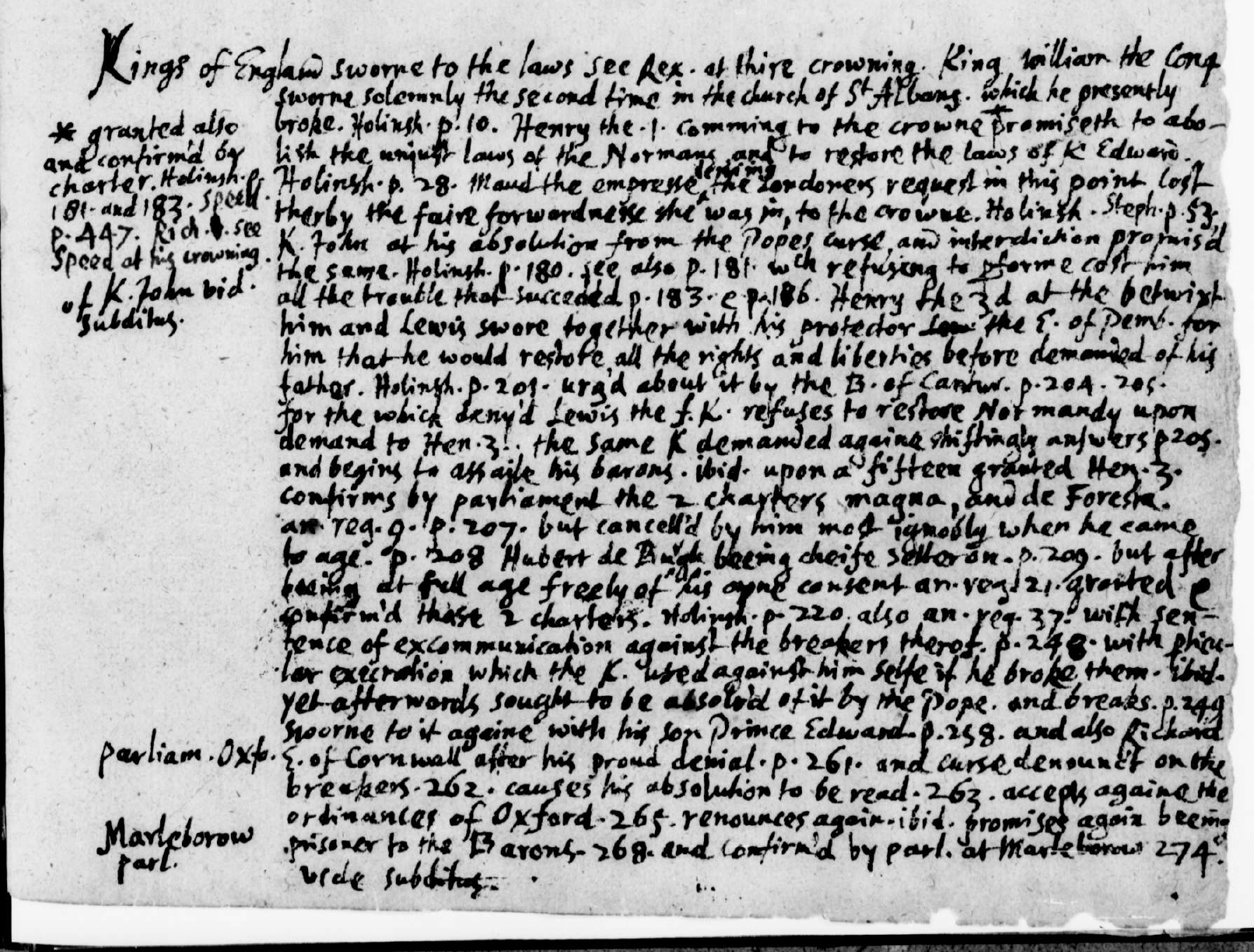
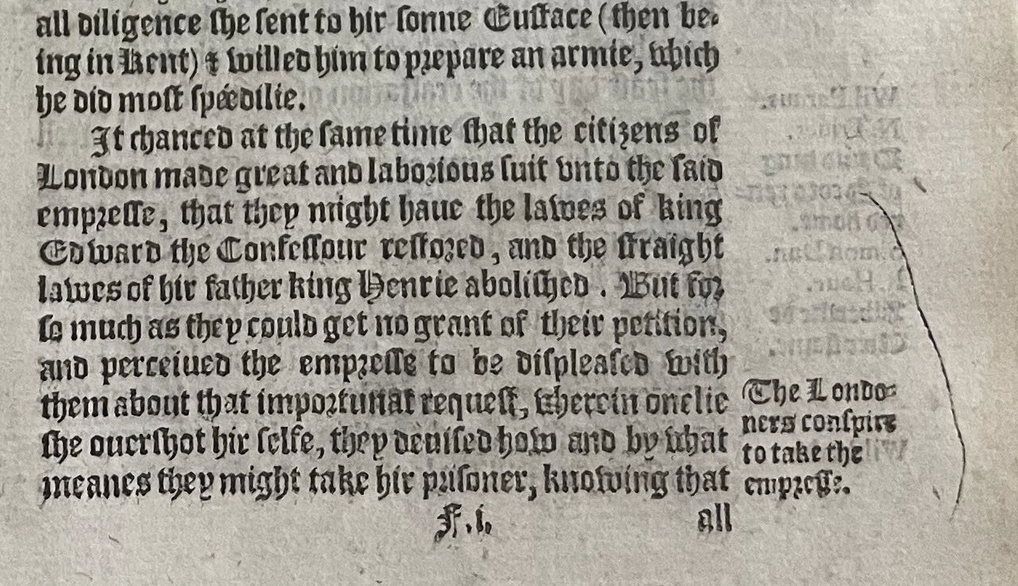
Fast forward to 2024 and another book from Milton’s library has resurfaced, which I’ve not yet had time to discuss here. At the end of March, scholars from Arizona State University hosted a Research Forum at the public library in Phoenix, with the aim of exploring a collection of books bequeathed to the library in 1958 by Alfred Knight, a real estate magnate and philanthropist. Among Knight’s books was a copy of Holinshed’s Chronicles (1587), a gargantuan work that charted the histories of England, Scotland and Ireland from their mythical origins through to the present day. And among the scholars present were Aaron T. Pratt (curator at the Harry Ransom Center, University of Texas at Austin), and the aforementioned Claire M. L. Bourne. Aaron spotted some marginalia that roused his suspicions; Claire took a look and confirmed those suspicions; and then Claire sent me some images to see if I agreed. The identification was relatively easy for us to authenticate, not just because of the handwriting, but also because Milton took detailed notes from his reading of Holinshed in his Commonplace Book (Add. MS 36354), now in the British Library. It was immediately clear that there were strong connections between the marks in the book and the notes. Here, for example, is an excerpt from the Commonplace Book, in which Milton collects evidence that kings of England (unlike American Presidents?) are not above the law. A few lines down he reports that the Empress Maud, failing to revoke the laws of the Norman invaders, lost the support of Londoners and with it her claim to the crown. And beneath that is the section of Holinshed from which he gleans this information, marked with a marginal bracket.
The match is by no means 1:1, but there are so many cases where the Holinshed ties up with the Commonplace Book evidence in this way that there can be no doubt that the annotator is Milton.
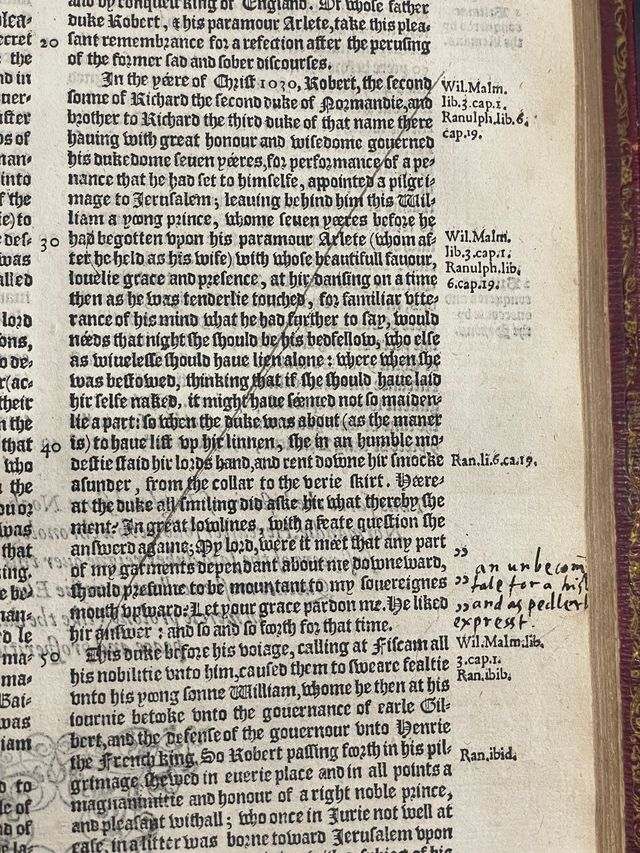
That said, there are so many annotations in this enormous book that it is going to take some time for us to process them and to work out they have to tell us about Milton’s reading practices. We published a preliminary account in the Times Literary Supplement in May; in that piece, the star exhibit was a photograph which shows Milton censoring his Holinshed by running a line across a passage which described how Arlete/Herleva, the mother of William the Conqueror, behaved when she was summoned to the bed of the Duke of Normandy. In the margins, he added a critical note: ‘An unbecoming tale for a history and as pedlerly expresst’ (or something like that–his words were cropped when the book was rebound). ‘John Milton was a prude‘ was how the story was covered in the online Daily Mail, offering news that may not have come as a huge shock to readers of Comus and Paradise Lost. Other images that we used in the article showed Milton citing other texts he had read, including Edmund Spenser’s View of the State of Ireland and ‘the booke of Provenzall poets’, i.e. Jean de Nostredame’s Les vies des plus célèbres et anciens poètes provençaux (1575), a book that was not previously known to be on his shelves.
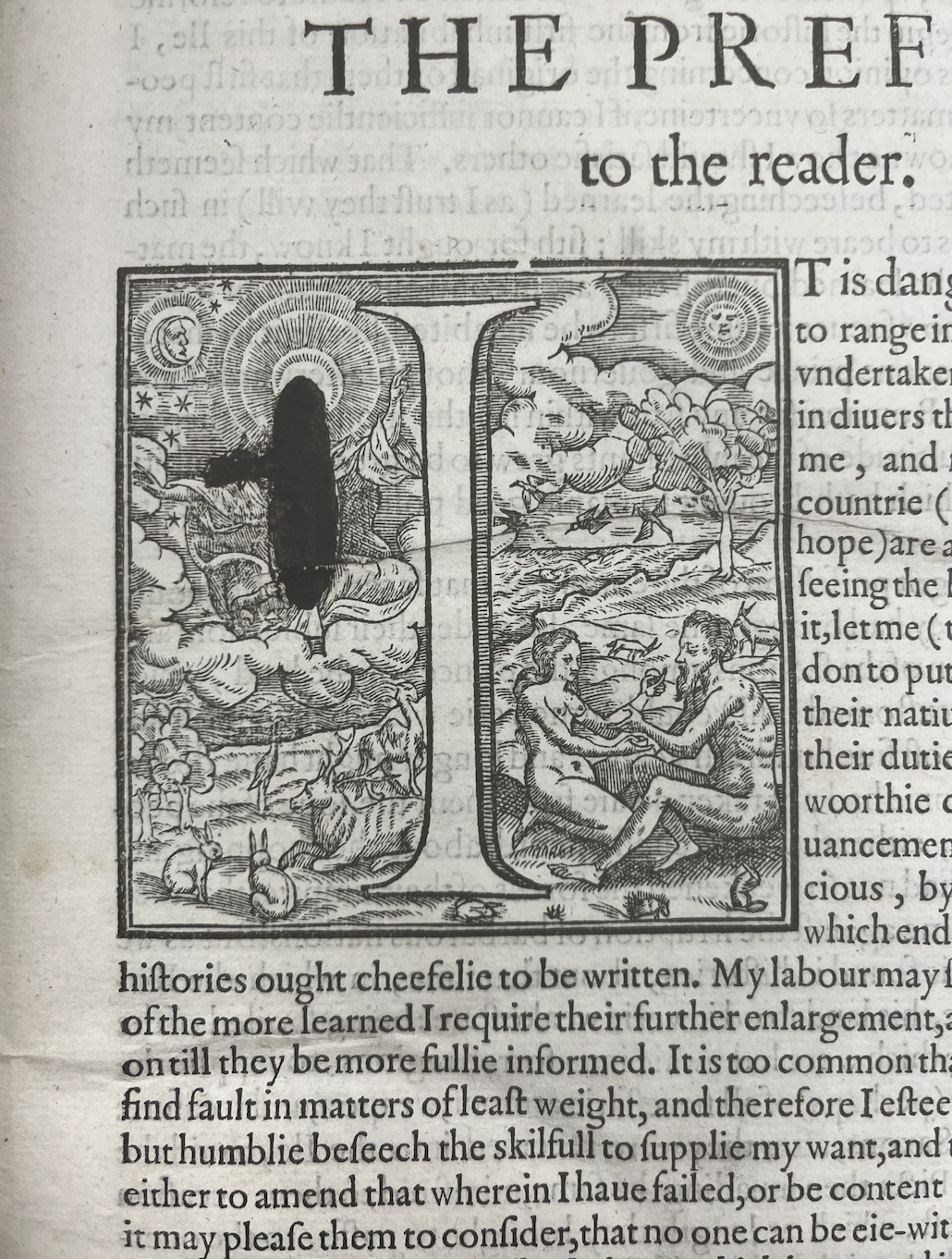
We thought we had found the juiciest images to illustrate our article, but we missed one that might just turn out to be the juiciest of all. This is the woodcut initial ‘I’ that kicks off the Preface to the second bound volume of the Chronicles. As you can see, it depicts Adam and Eve in the Garden of Eden, with the newly-created world all around them. But what is being covered up by that big black mark up in the sky to the left?
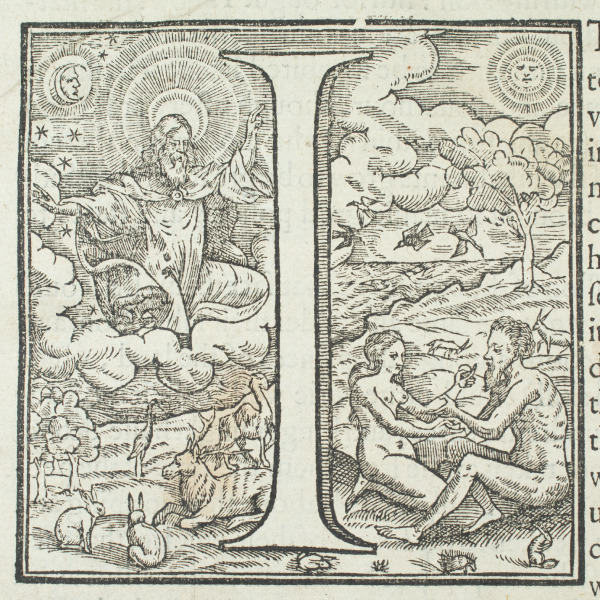
The answer is, of course, that it is God, as you can see by contrasting this version of the same letter, from a copy of the 1587 Chronicles at the Harry Ransom:
So what exactly is that black splodge doing, covering up God? The answer is, almost certainly, that this is another act of censorship. Protestants objected to the visual depiction of God, viewing it as an incitement to idolatry, and from the early sixteenth century (in a process documented by the historian Margaret Aston), pictorial representations were frequently replaced with the tetragrammaton, the four Hebrew letters for the God of Israel: YHWH. Holinshed’s image offended against a widespread prohibition; hence its vigorous correction in this copy.
The next question is: so who did the correcting, and was it Milton? In a recent article entitled ‘Milton among the Iconoclasts’ (in Depledge et al., eds, Making Milton: Print, Authorship, Afterlives [2021]), Antoinina Bevan Zlatar surveys the poet’s lifelong engagement with iconoclasm (at its most conspicuous in his prose work attacking the veneration of the executed Charles I, Eikonoklastes), but suggests that Milton did not adopt the extreme puritan position on the depiction of the deity. In Paradise Lost, Milton permits his God to have the kind of human features that he given in Scripture; this is a God who can be said to sit on a throne, and to have an eye that he can bend down to view his works. That said, Zlatar also reminds us that Milton casts God the Father as invisible, ‘throned inaccessible’ in a blaze of glory, and presents the Son as the visible form of the Father. So perhaps he did have difficulties with too defined and delimited an image of God, as ‘an old man sitting in heaven on a throne with a sceptre in his hand’ (to quote the contemptuous description of the puritan William Perkins). Determining the date and the origins of that smudge of black ink in the Holinshed will be tricky, perhaps requiring non-invasive pigment analysis. At this stage we can only say: it could be Milton.
In act 1 scene 2 of Shakespeare’s The Two Gentlemen of Verona, Antonio discusses his son with his friend Panthino. Panthino advises Antonio to let his son ‘spend his time no more at home’, and Antonio agrees:
I have consider’d well his loss of time
And how he cannot be a perfect man,
Not being tried and tutored in the world (1.2.19–21).
His son, Proteus, needs to travel out of his home environment in order to perfect himself as a man. To deny geographical mobility to a young man is also to cause him a ‘loss of time’: a temporal impediment to his intellectual development.
Texts, like people, move through time and space, altering as they do so. The Two Gentlemen of Verona comes down to us through four hundred years of printing and production history. If the ‘home’ of this play is the Elizabethan London in which it was written, it is also the Italian Renaissance in which the play is set. But it is additionally the places and moments in which the play has been read and performed since its conception. The RSC website records twelve productions in Stratford since 1879, each of which sets the play in a particular moment and provides its own interpretative spin. Meanwhile editions of the play range from the 1623 first folio to Mary Cowden Clark’s Shakespeare’s Works: Edited With a Scrupulous Revision of the Text (1860)[1], to the fourth Arden series edited by Tiffany Stern, Peter Holland and Zachary Lesser currently underway. The Two Gentlemen of Verona has undergone the kind of treatment recommended for Proteus: has already been, if not ‘perfected by the swift course of time’, then at least subjected to the cultural forces of centuries and places beyond its own.
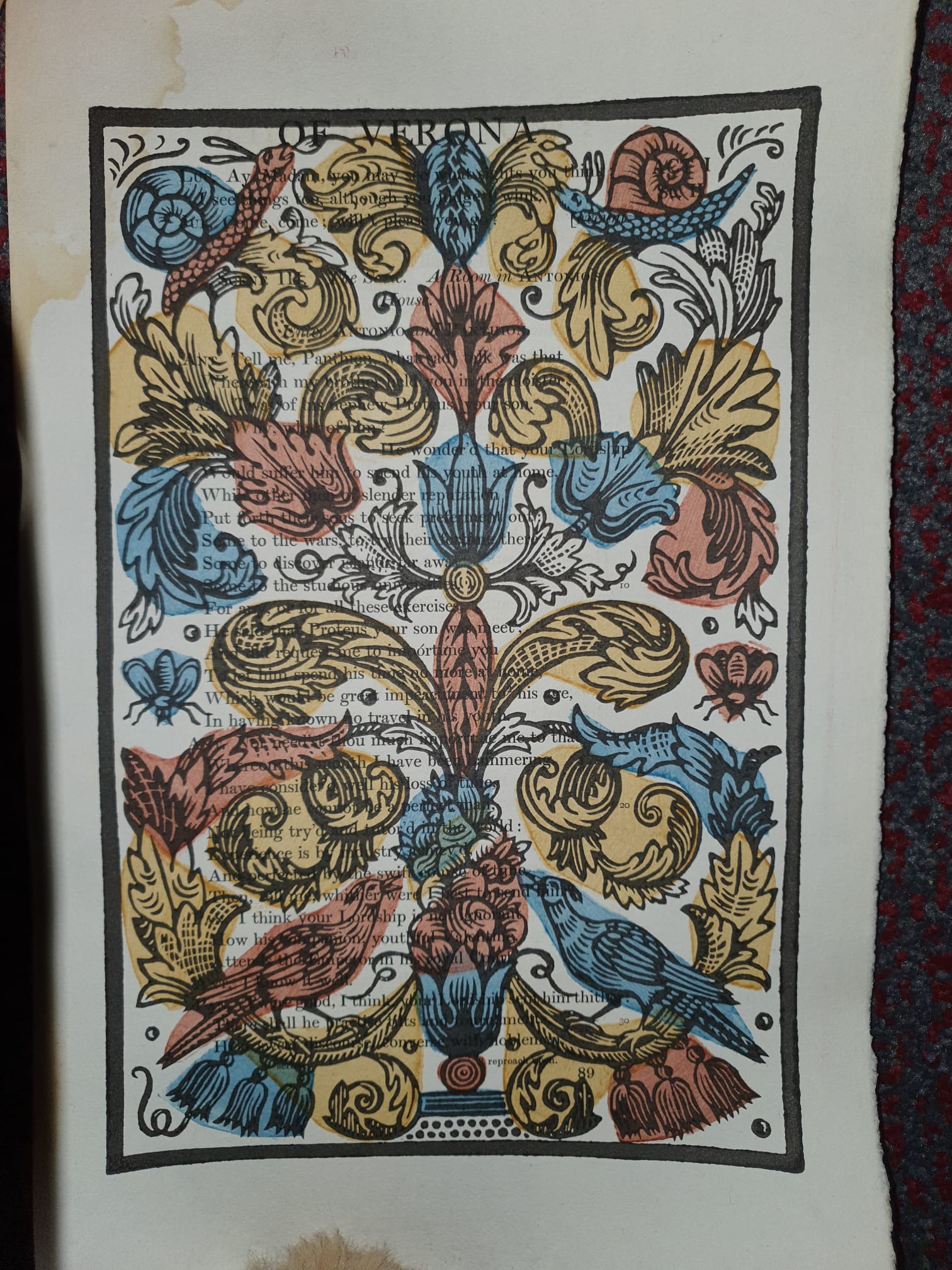
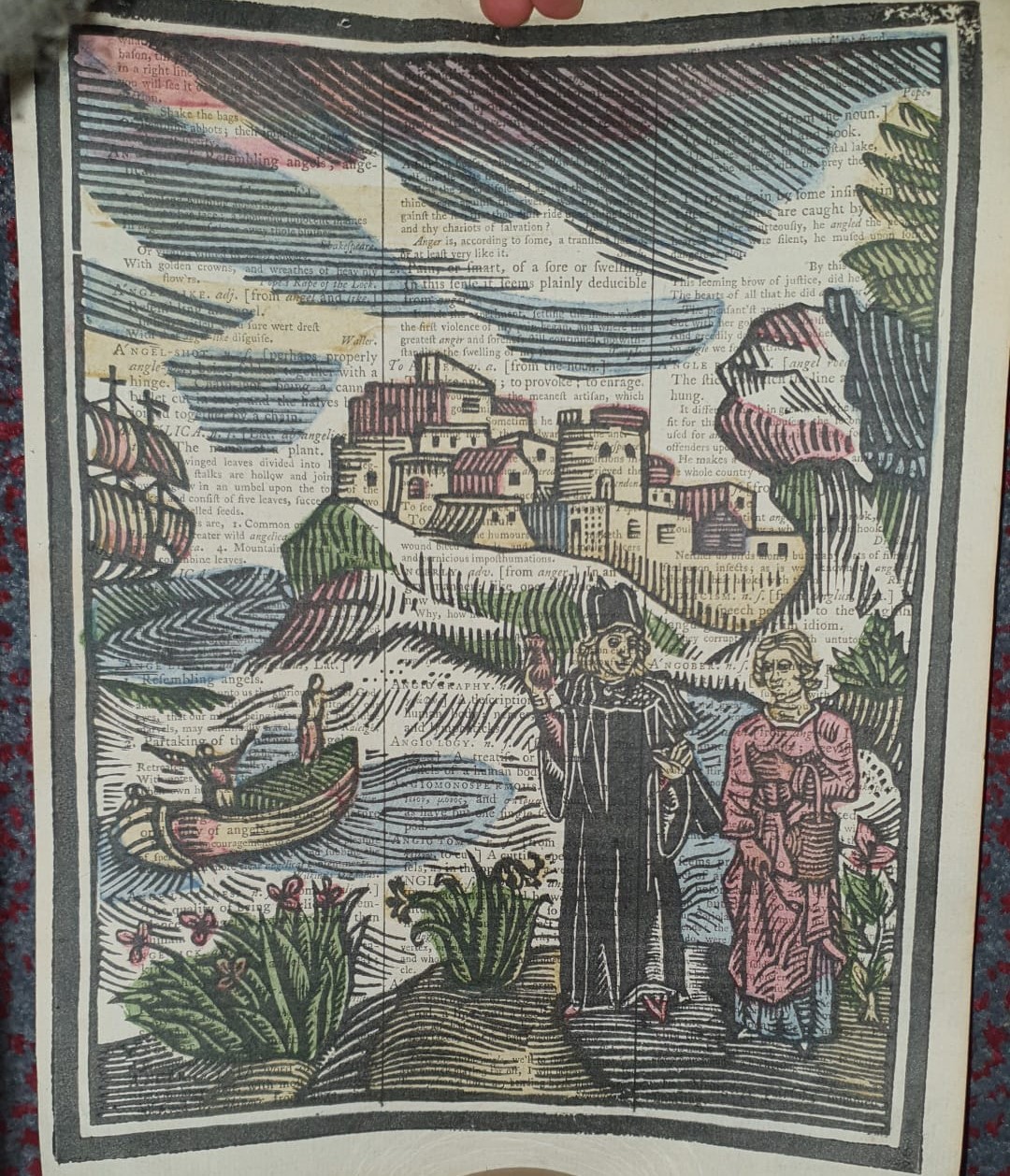
Recently I came across a copy of The Two Gentlemen of Verona which shed new light on these lines by showing quite how far a book could travel from its home context. I met with Jane and John Jeffery, decorative paper-makers or ‘buntpapierists’ based in Edinburgh, who use loose sheets and printers waste from the sixteenth to the twentieth centuries as a substrate for decorative printing.[2] The patterns that the Jefferys deploy on top of the texts are themselves taken from printer’s lace from other sheets in their collection, leading to a cycle of visual reuse and reproduction. Their collection includes loose sheets from the 1901 ‘Edinburgh folio’ of Shakespeare’s complete works, published by Grant Richards. Page 89 from volume one, which runs from ‘Ay Madam’ (The Two Gentlemen of Verona 1.2.138) to ‘converse with noblemen’ (1.3.31), is just one of the sheets which has been transformed into decorative paper. I had to check those lines against my own Arden Complete Works (edited by Richard Proudfoot, Ann Thompson and David Scott Kastan) because they have been partly hidden by the yellow, pink and blue flowers and insects that hover above the text. This is a fragment of Two Gentlemen of Verona which has been transformed into something new. Divisions of scenes, acts, and sentences are overruled by the unit of the page, which is no longer only an extract from a codex but the frame of a visually articulated space.
Another book whose pages the Jefferys have printed on is the sixth edition of Samuel Johnson’s Dictionary, printed in 1785. The pages aren’t numbered, but the one which runs from ‘angel’ to ‘angry’ can be identified as sig. L4r using the digital edition on Eighteenth Century Collections Online. About half of the text on this page is covered by the picture of two men standing by a body of water traversed by two boats, which divides them from a city in the background. The image erases many words and draws our attention to those which remain legible: ‘plainly deducible’ springs from the top of the central column, while ‘A’NGLE’ is reduced to NGL (Not Gunna Lie?!) The alphabetic logic of dictionaries like Johnson’s brings together seemingly semantically incongruous words, and in doing so suggests connection between them. Printing over a dictionary page while leaving only some of the words legible creates new narratives out of what is already there. We might now read this page as a text about Milton’s Paradise Lost, from which Johnson quotes the line ‘fair angelick Eve’ (now buried under ink), and whose epic narrative opens with the war between the angel Lucifer and the ‘angry Victor’.
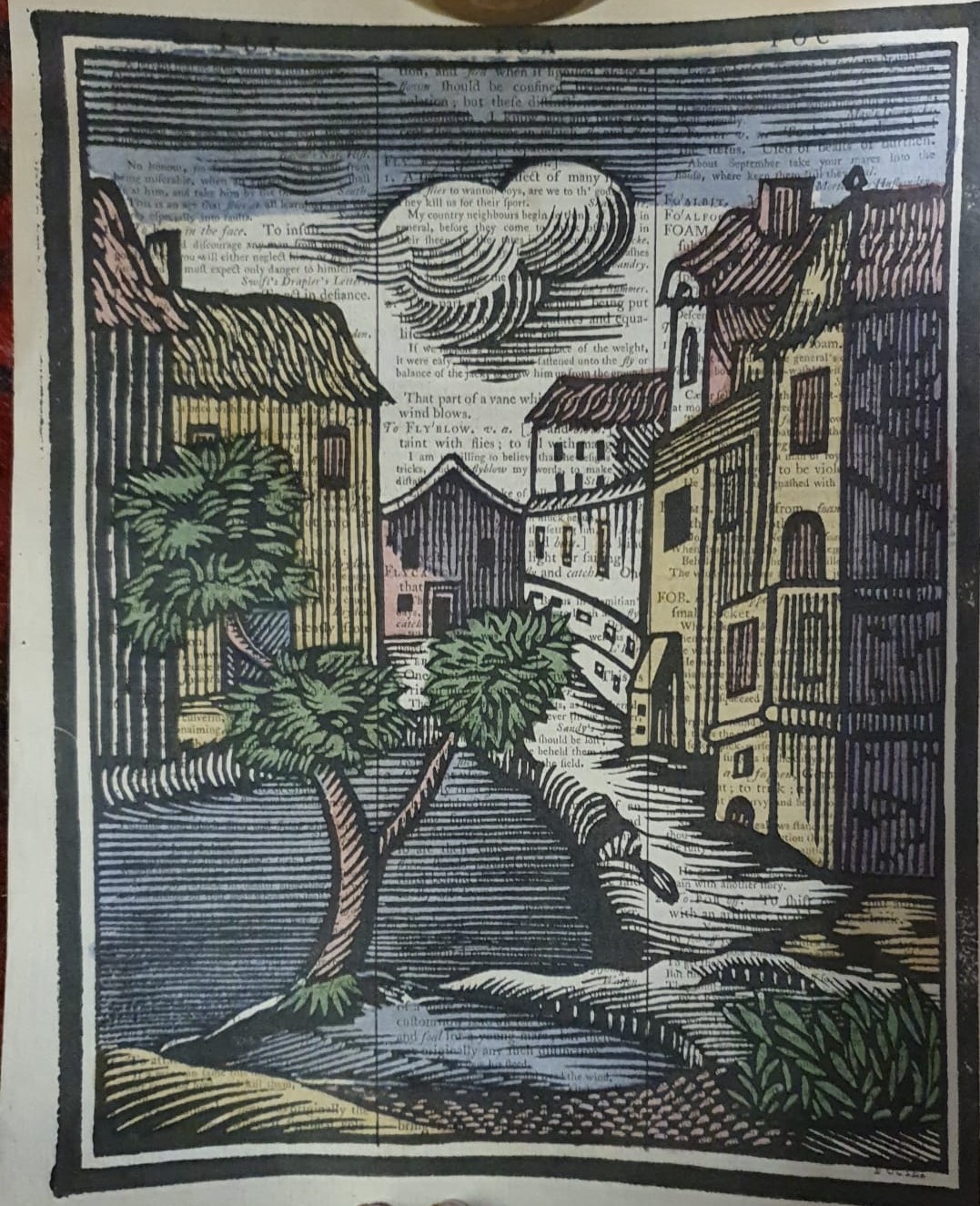
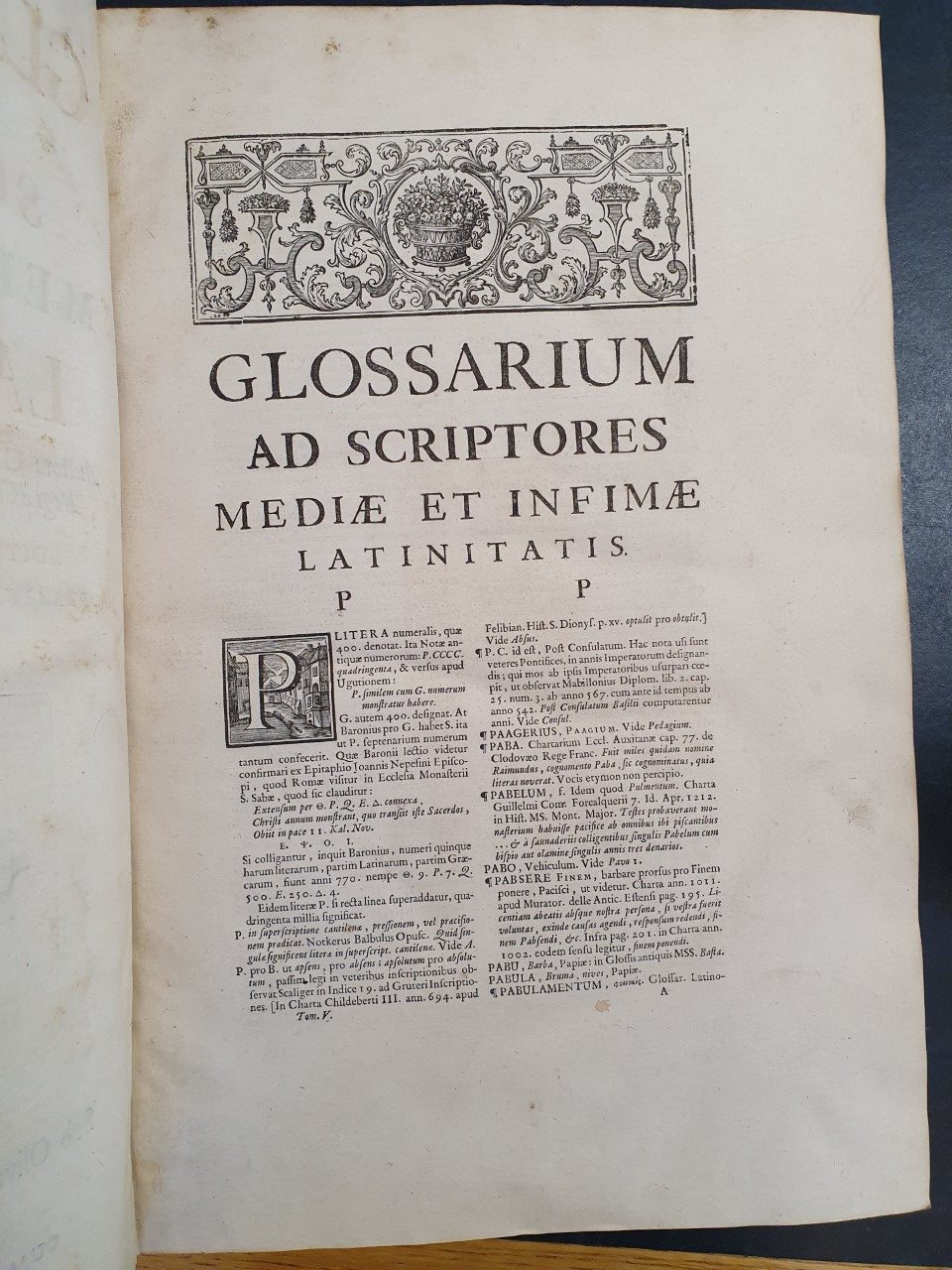
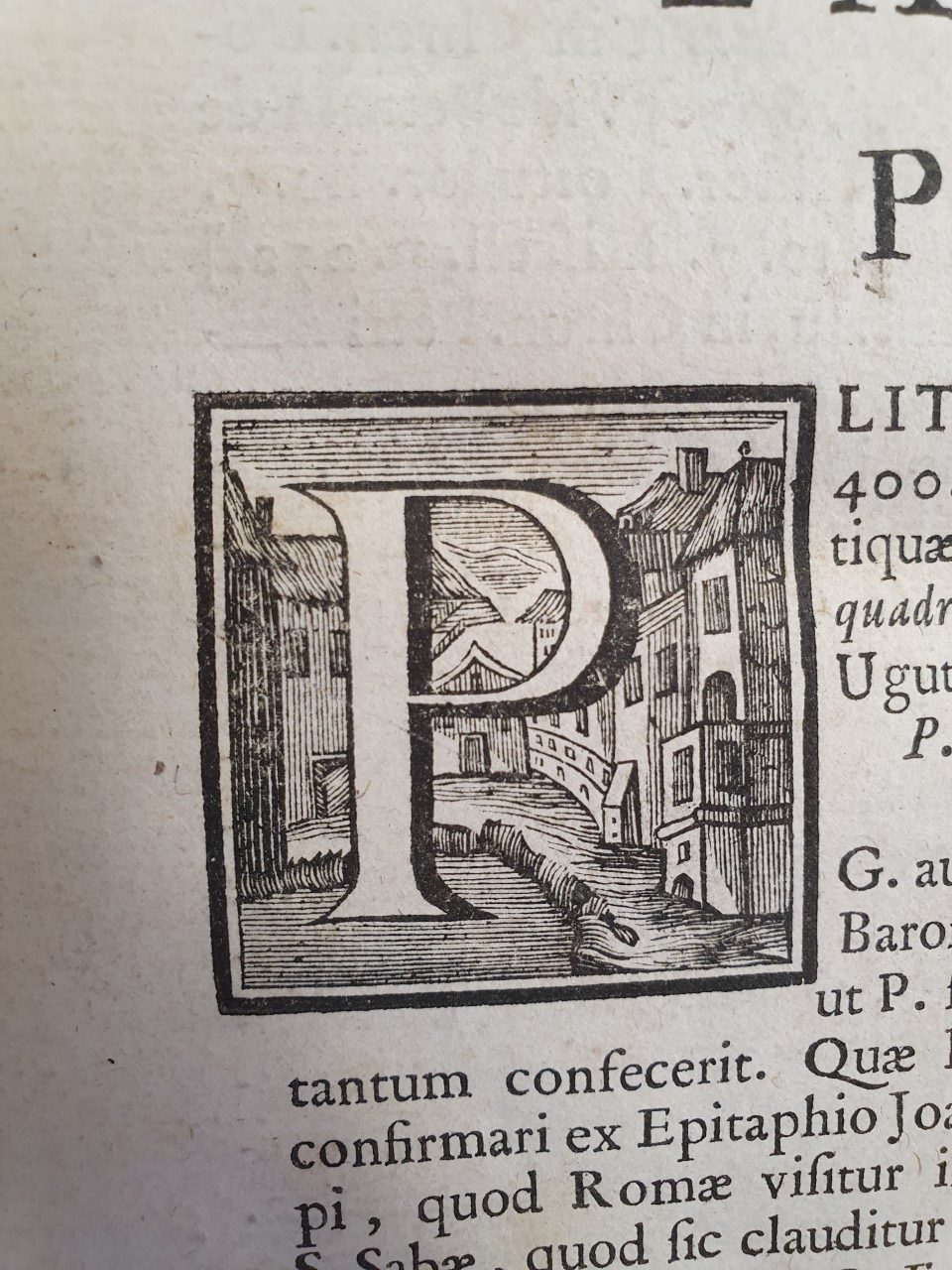
The treated pages of Johnson’s dictionary make other connections between the text in question and the illustration layered on top. Sig. 5G4r, which runs from ‘To Fly in the face’, to ‘Focae’, has been almost entirely printed over by an image of a street, with houses running down either side and a pool of water in the foreground. This scene has been taken from the background to the illustrated capital ‘P’ from sig. A1r of Charles Du Fresne’s Glossarium mediae et infimae Latinitatis (Glossary of writers in medieval and late Latin), initially published in Paris, 1678, and then reprinted in the 1730s. It is this later edition which provided the image printed on top of the page in Johnson’s dictionary, except that the P has been done away with and the engraving blown up to fill an entire page. Knowing where this image came from catapults a French historian onto a page otherwise heavily populated by an Anglo-Irish canon of Shakespeare, Pope, Dryden, and Swift, and weaves a thread between Du Fresne’s Glossarium and Jonson’s Dictionary. Both books share a certain agenda, which is to construct textual histories (whether of writers or of etymologies) that come with their own political, historical, and cultural value systems.
There is a history of treating pages of books to create new texts. The recently deceased Tom Philips (1937–2022) endlessly reworked W. H. Mallock’s conservative novel The Human Document (1892) to make a new satirical narrative.[3] That narrative was itself illustrated by the images with which Philips covered much of Mallock’s prose, leaving only fragments to tell another story. The work of the Jefferys was, they tell me, propelled less by the text and more by the affordances of the paper to support their visual designs. Nevertheless the paper’s original role – as a substrate for an eighteenth-century dictionary and for an early twentieth-century edition of Two Gentlemen of Verona – refuses to fully subside. Text and image play off one another into receding horizons of intertextuality, generated through bibliographic and linguistic quotation. What we have here is a fragment from Jonson’s dictionary from 1785, itself a reprint from 1755, which has been printed over with an image taken from the second edition of De Fresne’s Glossarium, which predates the dictionary by over seventy years. Early modern texts which survive today are inevitably ‘tried and tested by the world’. While this is less the teleological march towards perfection which Antonio desires for his son, it is instead a messily generative story of intertextuality, told through palimpsest, erasure, and juxtaposition.
[1] For a history of women editing Shakespeare see Molly Yarn, Shakespeare’s ‘Lady Editors’: A New History of the Shakespearean Text (Cambridge: Cambridge University Press, 2022).
[2] For the early modern history of recycling printed paper as decorative paper, see Juliet Fleming, ‘Damask Papers’, The Elizabethan Top Ten: Defining Print Popularity in Early Modern England, eds. Andy Kesson and Emma Smith (Ashgate: Surrey, 2013), 179-191.
This summer, I worked as a Research Associate on the pilot project, ‘Recovering the Lost Library of John Milton’, which was generously funded by the Cambridge Humanities Research Grants Scheme. This project sought to build upon Jason Scott-Warren and Claire M. L. Bourne’s discovery of John Milton’s copy of Shakespeare’s First Folio at the Free Library of Philadelphia, which gained significant media coverage worldwide and even served as the basis for one of the questions in an episode of Jeopardy! which aired on 17 May 2022.
I was given free rein to think about how I might approach the tracking down of the rest of Milton’s library in the short timeframe of eight weeks; a daunting task, given the wealth of scholarship on this topic by scholars such as William Poole, let alone the number of books that must have passed through Milton’s library during his lifetime.[1] Only nine volumes have been identified as belonging to Milton; many others have since been disputed or dismissed as spurious.[2] While it is not the place of this blogpost to rehearse the numerous scholarly conjectures on the immediate journey of Milton’s library following his death, it is suffice to observe that, as Scott-Warren and Bourne’s discovery has shown, there is no easy way to predict where Milton’s books may have ended up.[3]
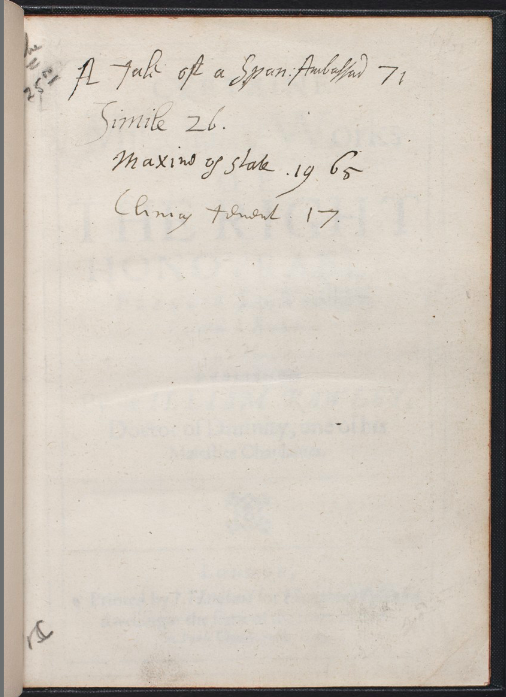
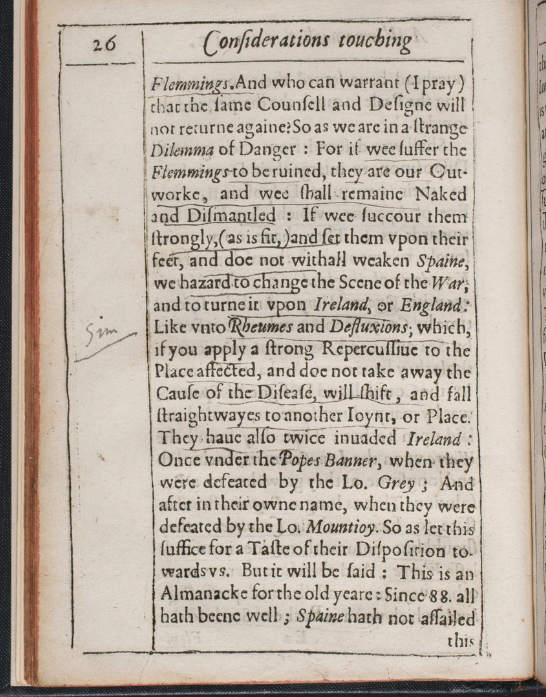
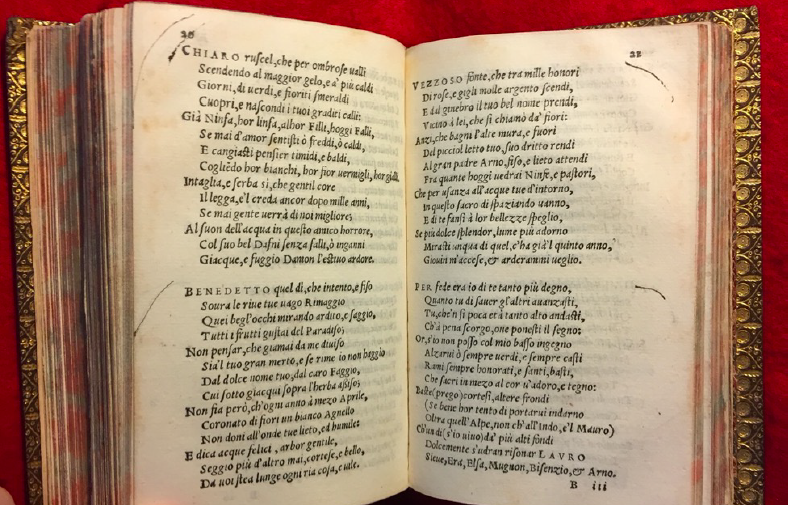
Former Research Associate, Taylor Hare (PhD candidate, Penn State University), laid the groundwork for my assignment in a number of ways, most notably by contacting numerous librarians in the UK and the USA in order to procure photographs of various annotated texts held in their collections which Milton had cited in his commonplace book (British Library, Add MS 36354). The principal caveat I was given before delving in was that I was only to investigate books published before 1652, the year Milton became blind. I began by thinking about the resources which were already available to me, starting with the invaluable digitised collection of annotated books at the William Andrews Clark Memorial Library, UCLA.[4] While the bulk of the Clark’s collections can be dated to 1650–1830, thereby mostly falling outside the remit of the project, there were a number of books which contained pre-1650 annotations, such as William Rawley’s Certaine Miscellany Works of The Right Honovrable, Francis Lo. Verulam (London, 1629) (PR2207.9 .C51 *). The Clark’s copy of this text contains a number of annotations throughout in several seventeenth-century hands. The rather half-hearted line accompanying the abbreviation ‘sim’ (i.e. ‘simile’) on page 26 bears some resemblance to Milton’s trademark ‘shoulder’ brackets to be found in his copy of Shakespeare’s First Folio, described by Scott-Warren and Bourne as ‘an often crudely executed, curved stroke’ (see Figures 1b and 2).[5] However, the ‘Simile 26’ on the flyleaf, which refers to this marginal note, is clearly not written in his hand; among other things, the ascender of the ‘l’ is too florid to be Miltonic (see Figure 1a).
fig. 1a
fig. 1b
fig. 2
After consulting the Clark’s digitised collection, my second task was to call up copies of various texts which Milton consulted, using the evidence from his commonplace book. This served as a concrete starting point, despite the fact that most of the nine surviving books owned by Milton are not actually cited in this manuscript.[6] I also chose two texts not listed in the ‘Primary Bibliography of Editions Used by Milton’ compiled by William Poole; namely, The Dippers dipt (London, 1645), a history of the Anabaptist movement since the Reformation, which was composed in prison by Daniel Featley, the Royalist theologian and controversialist; and the Royalist pamphlet, An Inquisition after Blood ([London], 1649), published anonymously by James Howell, which is cited in the second edition of Milton’s Readie and Easie Way to Establish a Free Commonwealth (London, 1660).[7] As a corollary to Poole’s observation that Milton ‘rarely took notes’ from pamphlet literature, in addition to scholarly conjecture that he may have stopped signing his books in the 1640s, it might be the case that Milton annotated these Civil War pamphlets instead; they would certainly have been cheap enough to own in abundance.[8]
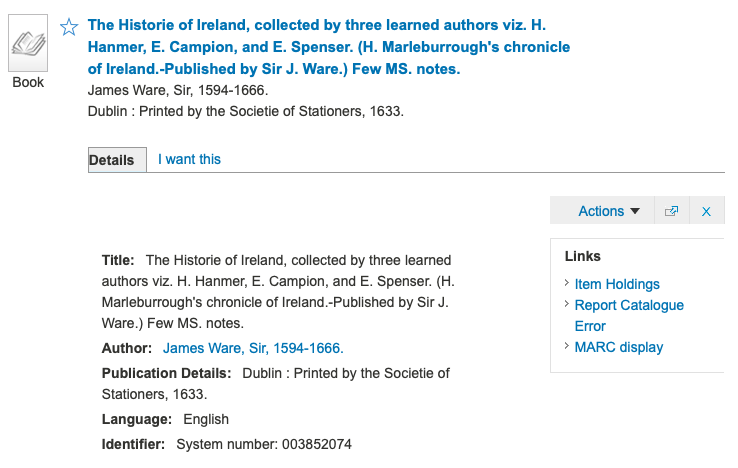
With regard to the texts listed in Poole’s ‘Primary Bibliography of Editions Used by Milton’, I would only call up specific editions identified with certainty as those which Milton consulted (for example, the 1545 edition of Roger Ascham’s Toxophilus).[9] Secondly, I would concentrate on copies about which provenance information was scarce or non-existent, in the hope that I might discover some uncatalogued marginal annotations and markings. Therefore, I did not examine copies of texts at archives such as Lambeth Palace Library which had already been identified as belonging to key contemporary figures of the Church, from Archbishop William Laud to Archbishop Gilbert Sheldon, which were unlikely to have passed through Milton’s hands.[10] In contrast, there were many examples within the British Library online catalogue which would specify the presence of ‘m. s. notes’, but with no further provenance information provided (see Figure 3). I also deemed it a worthwhile exercise not to rule out texts owned by individuals who had died within Milton’s lifetime; as Poole’s discovery of Milton’s copy of Giovanni Boccaccio’s Vita di Dante (Rome, 1544) has shown, Milton was not averse to buying copies owned by near contemporaries.[11] Furthermore, as scholars remain uncertain as to when Milton de-accessioned his books (if at all during his lifetime), I decided not to dismiss entirely the books of Robert Ashley, the translator and book collector who died in 1641, bequeathing all his books to Middle Temple.
fig. 3
Being based in London, I had the opportunity to travel easily to a wide variety of locations in search of Milton’s books. Many individual copies at libraries such as the National Art Library, the Institute of Historical Research Library, and the Special Collections at UCL Library are not catalogued on the ESTC or the USTC.[12] Drawing upon my familiarity with other archives beyond London, I also took the opportunity to travel much further afield to places such as Durham Cathedral Library. Having spent a month in Durham earlier in June to work on my own research, I was aware that the printed books at the Cathedral Library were yet to be catalogued electronically or linked to the USTC, meaning that it was likely that they had not been examined in great detail in recent years.
In the end, I found very little. Out of the 252 books I examined in July and August, 110 contained no annotations whatsoever. While Leah Marcus and Stephen B. Dobranski might be correct to some extent that ‘Milton’s hand was not all that distinct among Renaissance writers’, the way in which he annotated his texts is certainly distinguishable from many contemporary book owners.[13] Evidence of readerly engagement of any kind, if not Milton’s, was disappointingly conventional in many copies I examined; nor were there any instances of hand-colouring or drawings, or objects (or indeed the ghosts of objects) such as pressed flowers, scissor marks, or pins to be found.[14] I looked out especially for the curvy brackets which were such a key feature of the annotations in his copy of Shakespeare’s First Folio; his distinctive manner of keying his marginal annotations with asterisks (and latterly crosses); his use of ink rather than pencil; his adherence to an italic hand, as opposed to mixing secretary and italic forms; and his marked lack of underlining.
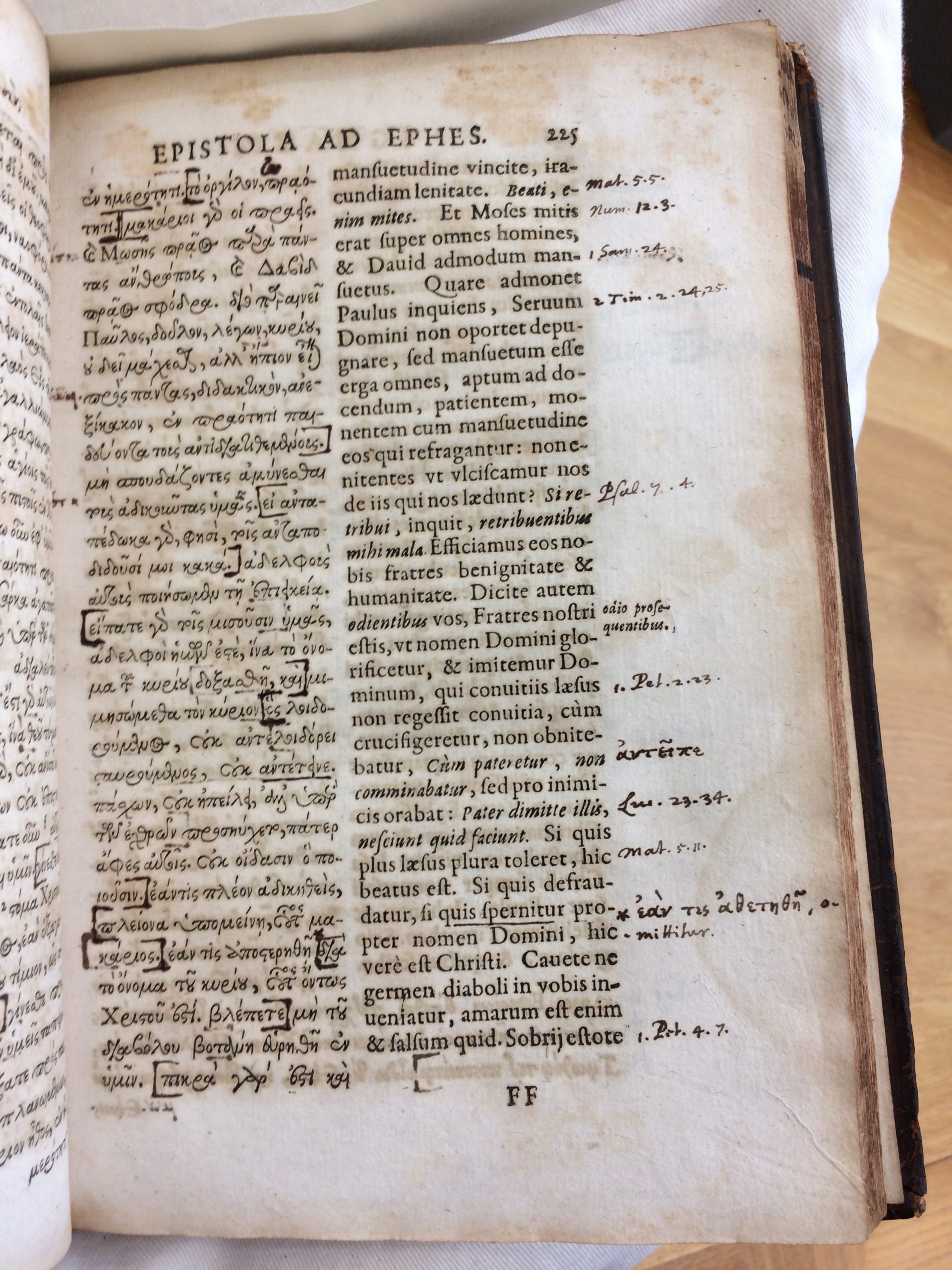
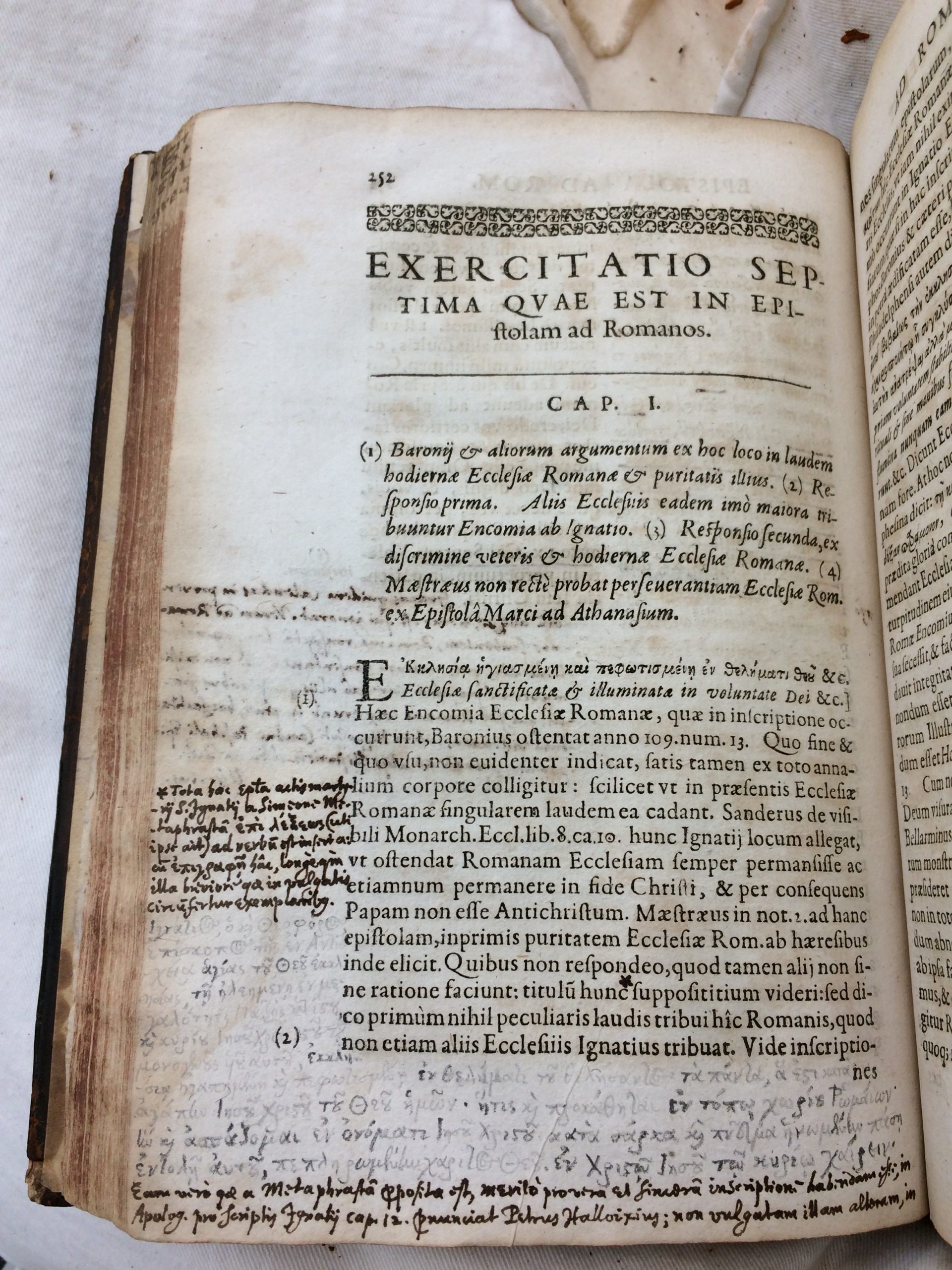
Perhaps the only copy I consulted which featured annotations remotely resembling Milton’s hand was Ignatius of Antioch’s Quæ extant omnia (Geneva, 1623), held at Durham’s Palace Green Library. This volume was previously owned by Martin Joseph Routh (1755–1854), a scholar of patristics and President of Magdalen College, Oxford, who bequeathed his large collection of approximately 16,500 printed books to Durham University. One ‘Nath. Walker’ and one ‘John Hilton’ (so close!) inscribed their names on the opening flyleaf; Hilton’s signature can also be found on the title page. Hilton had purchased the copy for 3 shillings and 6 pence, while Walker had bought it for 4 shillings and 3 pence. While it is difficult to identify these two individuals with certainty based on the names alone, it is possible, owing to the Durham connections and judging by the mid-to-late seventeenth-century italic hand, that Hilton was the John Hilton who was the son of John Hilton, Esq., of Monkwearmouth, County Durham. According to Venn’s Alumni Cantabrigienses, John Hilton the younger was born at Whitwhell House, County Durham, and was educated at Houghton-le-Spring. He was admitted pensioner, aged sixteen, at St John’s College, Cambridge, on 7 September 1635, but he did not take a degree. Admitted at Gray’s Inn less than three years later, he served as captain in the King’s service and succeeded his father at Hilton Castle. He was buried in 1670.
fig. 4a (click on image to expand)
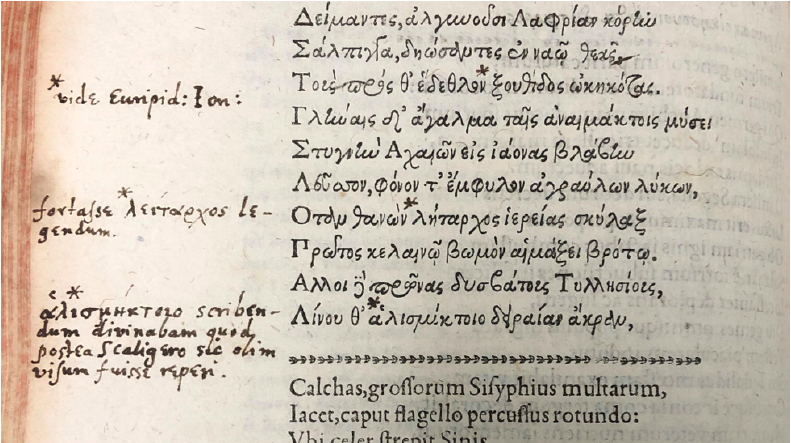
Durham University’s online catalogue gives no indication whatsoever of the sheer volume of marginal annotations in Latin and Greek on the pages of this copy, in no fewer than five different hands dating from the seventeenth and eighteenth centuries. I was struck especially by the way in which the annotator used asterisks and crosses to key certain words to marginal annotations, and the resemblance of many letter forms (including the capital letter ‘I’/’J’) to Milton’s (see Figures 4a–b and 5). The attribution falls short on account of the shape of the asterisks; Milton preferred a six-point asterisk, whereas the examples throughout this copy were consistently five-point asterisks. There is also rather too much variation in the execution of the ‘e’s; Milton only tended to use the italic ‘e’ and epsilon ‘e’, favouring the former in his later years, where the backwards secretary ‘e’ is also frequently in evidence.[15]
fig. 4b (click on image to expand)
fig. 5
In any case, this summer has proved a valuable experiment in blue-sky thinking, bringing to the fore a number of practical questions. Milton’s appetite for reading was large, and scholars have long been aware of his active book-buying. How, then, might one continue to conduct a project of such scope? From an environmental perspective, it might be difficult to justify flights across the Atlantic to consult single copies of, say, The chronicle of Ihon Hardyng (London, 1543), held at Goucher College and the University of Wisconsin-Madison. An alternative option would be to email numerous librarians for photographs of annotations. This was more of a necessity than an option for my former colleague Taylor Hare, who worked on this project primarily from home in 2021 when libraries were operating restricted visiting hours. In addition to emailing librarians for photographs, Taylor also worked from digitised copies using Google Books and EEBO. As discussed earlier, this was an approach which I initially took when I examined heavily annotated copies of texts digitised by UCLA’s Clark Library.
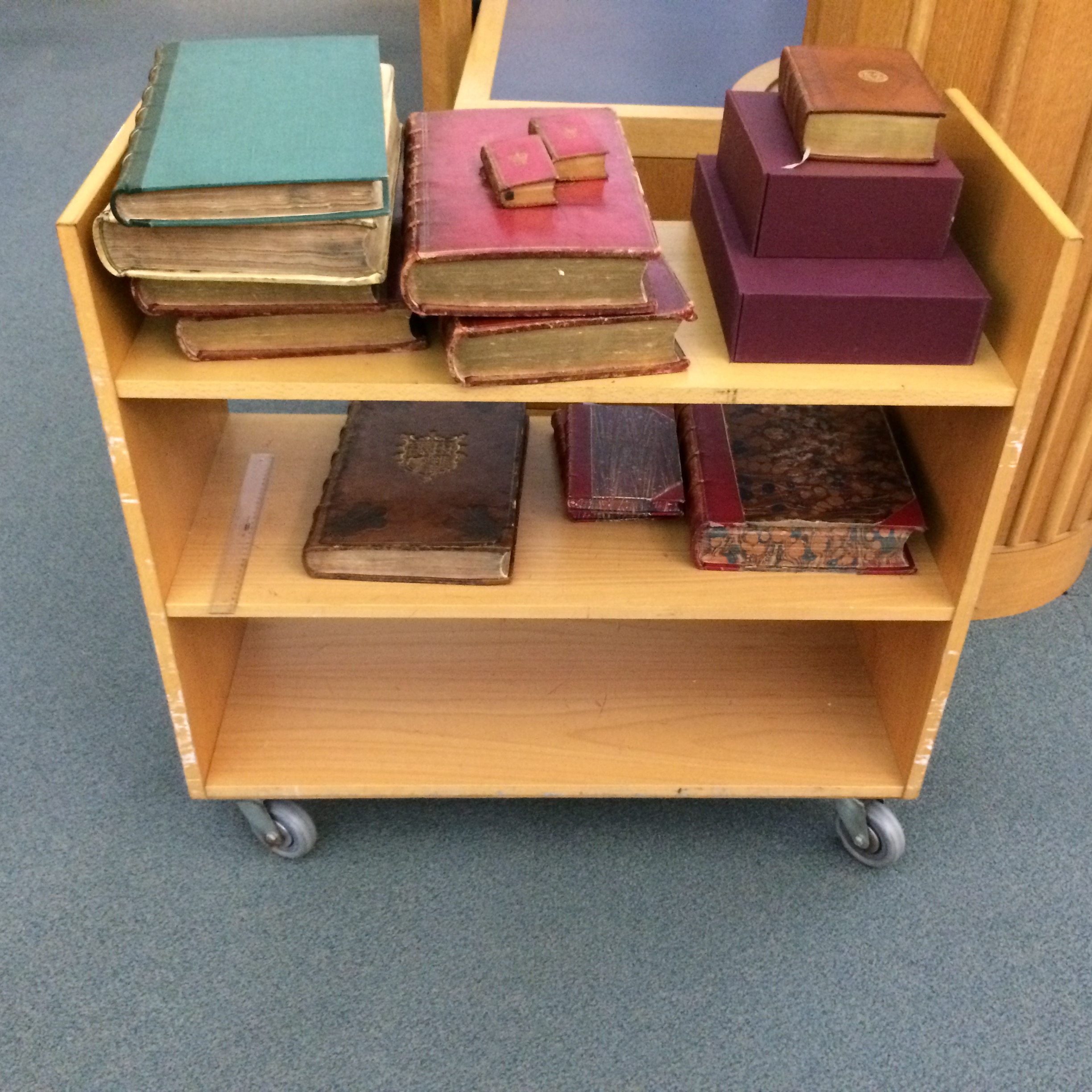
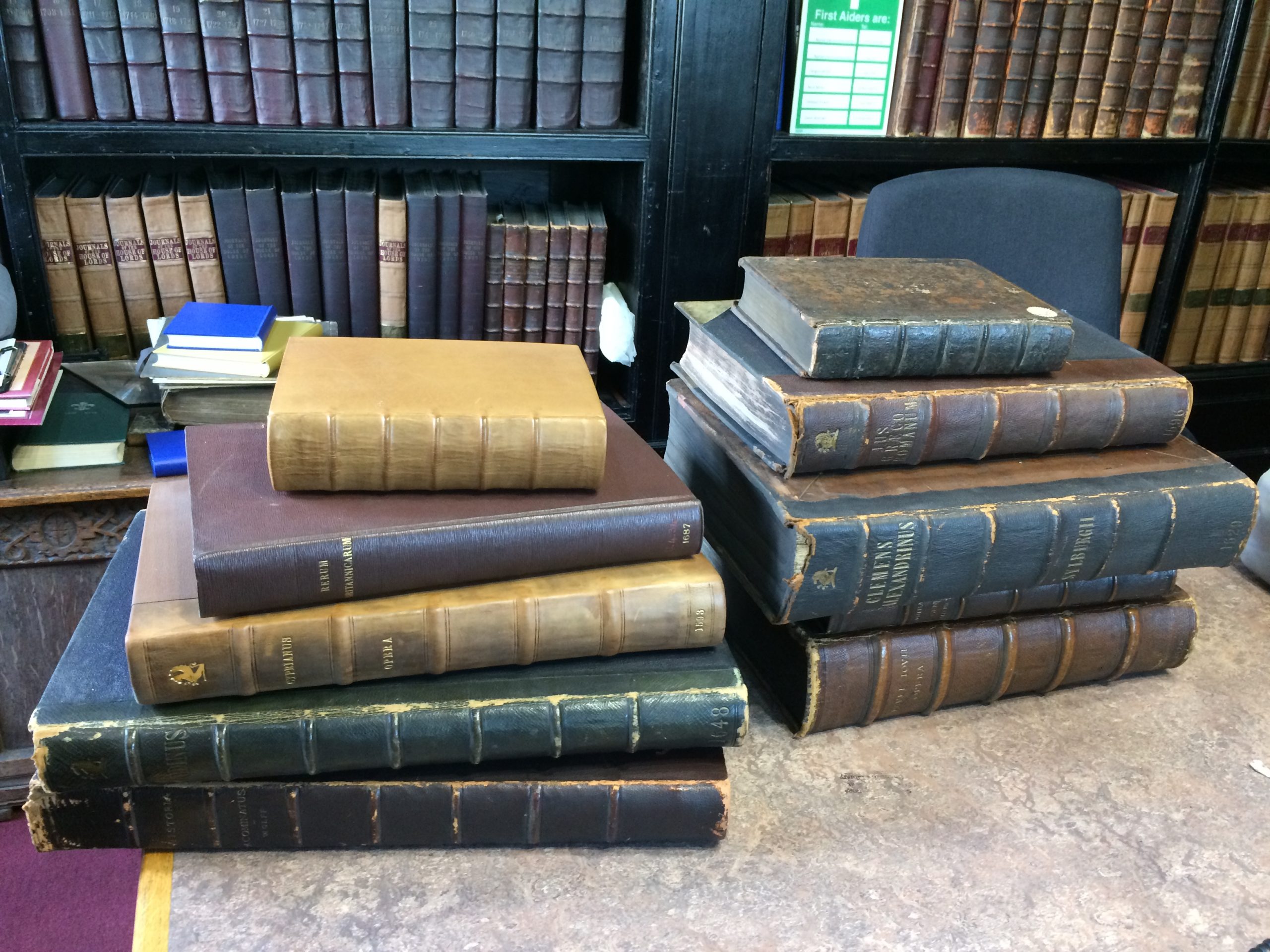
However, for such a project, one cannot rely on digitised images alone. In order to get a better sense of the types of books Milton was consulting, thinking further about the practicalities of owning such a library, one must give due consideration to the formats of the books (see Figures 6 and 7).[16] The standard catalogue descriptions of folio, quarto, and octavo fail to do justice to the variations in size within these three formats, and especially between books printed in England and those printed on the Continent. The smallest book I called up by far was Africæ descriptio IX lib. absoluta, trans. Joannes Florianus (Leiden, 1632) by Joannes Leo Africanus; the two volumes held at the British Library measure just 11 cm × 5.7 cm each, including the bindings (166.a.19. and 166.a.20.). It would have been very difficult to get a sense of the diminutive scale of these books by consulting digitised copies alone. On the other hand, the largest book I examined was Georgius Codinus’ De officiis magnæ ecclesiæ et aulæ Constantinopolitanæ (Paris, 1648). The John Rylands Library copy (shelfmark: 4973) measured 44.8 cm × 30 cm, including the binding. While current scholarship suggests that Milton spared little expense in buying books, the question remains as to whether Milton would have had the resources to own this particular book. Might it have been more likely that he consulted this particular tome in a library? Indeed, there appears to have been some reluctance by former owners to write in this very large book; there were no markings in any of the eight copies I examined.[17]
fig. 6
fig. 7
What other steps can we take to track down Milton’s books, and what other questions remain? It might be useful at this point to outline further a series of caveats and research problems. Firstly, it may be the case that Milton may have consulted certain books but not annotated them. Sharon Achinstein has already referred to numerous instances of ‘source-citing-but-not-reading’ in her exploration of the intermediary sources which he used to access the citations of Reforming worthies.[18] Perhaps there is a case to be made for Milton ‘reading-but-not-annotating’, or collecting books which he never got around to reading, storing them away in chests.[19]
Secondly, as my research in London alone showed, we remain restricted by various gaps in the databases available to us; the ESTC and USTC does not list every known copy of the texts which are available in public libraries. To provide one final example, the USTC states that there is only one public copy of the Codinus mentioned above – at the Bibliothèque Nationale de France – when in fact Oxford alone holds thirteen copies, and WorldCat lists a considerable number of copies held worldwide. It is also possible, of course, that Milton’s annotations could lie in books which are currently in private hands.
Thirdly, it would be useful to build upon the invaluable work of Peter Beal’s Catalogue of English Literary Manuscripts (CELM) by drawing up a full list of presentation copies of Milton’s own works which may have been annotated by him.[20] I was unable, for instance, to examine an annotated presentation copy of Areopagitica, owing to its inclusion in the British Library’s ‘Breaking the News’ exhibition (22 April 2022–21 August 2022).[21] The process of investigating potential presentation copies to confirm their authenticity or to relegate them to the large collection of spurious books would enable us to further consolidate the idiosyncrasies of Milton’s hand and orthography. The tracking down of annotated books more generally might still prove to be a fruitful approach, in the likely scenario that such annotations have not been attributed; in which case, Henry Richards Luard’s Catalogue of Adversaria and Printed Books containing MS. Notes (Cambridge, 1864)for books at Cambridge University Library might possibly be instructive.
We need to continue tracking the citations and sources which informed Milton’s writings, published and unpublished. While it might take some dedicated sleuthing to determine the exact editions from which the epigrams on the title pages of his publications were lifted, one place to begin might be to locate the copies of works to which Milton responded, or works which influenced him heavily, including the published works of his friends.[22] The Ivdgement of Martin Bucer, concerning divorce (London, 1644) and Bucer’s De regno Christi (Basel, 1557) influenced the composition of Milton’s second divorce tract published in 1644. Perhaps Milton might have bought An Answer to a Book, intituled, The doctrine and discipline of divorce (London, 1644), as he responded directly to it with Colasterion ([London], 1645). In 1650, the Council of State ordered Milton to publish a direct reply to Claudius Salmasius’ Defensio Regina, Pro Carolo I ([Leiden], 1649); he duly produced Pro Populo Anglicano Defensio (London, 1651). And, of course, there is John Gauden’s Eikon basilike ([London], 1649), to which Milton responded with Eikonoklastes (London, 1649).
Finally, to turn towards issues which have yet to be addressed: while there has been a rich body of research debating Milton’s position on image debates in the long English Reformation, the question as to how Milton may have responded to images in books remains ripe for investigation.[23] One of the most beautifully produced editions which I called up this summer was Giacomo Filippo Tomasini’s Petrarcha Redivivus, Laura Comite (Padua, 1635), which contains numerous portrait engravings. It seems unlikely that Milton would have extra-illustrated his books, executed elaborate drawings, or combined the techniques of drawing and pasting to embellish them;[24] on the other hand, William Poole conjectures that he may have taken the pains to colour in his (untraced) copy of John Guillim’s A display of heraldrie.[25] At a later point in his life, Milton would complain about the price of illustrated books, stating that pictures were of no use to him as a blind man.[26]
Perhaps connected to such questions would be the question of Milton’s engagement with book arts. Once again, judging from the evidence we have, while we know that Milton kept his books in good condition and annotated them with care, it does not seem likely that he required elaborate bindings or decorated the fore-edges of his books. (I called up a copy of John Foxe’s Book of Martyrs (seventh edn, London, 1632) (Durham Cathedral Library, I.IV.33-35), simply because the binding was stamped with ‘I M’, but found no annotations other than ‘Ex dono Tho: Comber [Thomas Comber (1645–1699), dean of Durham] Dec. Dunelm 1694’ inscribed on the title pages of the first two volumes, with the ‘1694’ omitted in the third volume.) Moving from the material to the musical, it also remains to be seen as to whether Milton’s music books, shipped from his travels in Italy back to England in 1639, will ever be recovered.[27]
The mysterious whereabouts of Milton’s library has continued to fascinate academics, librarians, and bibliophiles for centuries. If I had more time on this project, I would have looked into various titles dating from the late seventeenth and early eighteenth centuries with the words ‘Bibliotheca’ and ‘Catalogus’ in them, in order to discover if any of the nine books owned by Milton were sold together as part of another person’s library. I would also have investigated each of the previous owners of Milton’s nine books, from the clergyman and biographer Thomas Birch (1705–1766) to Victor Rothschild, 3rd Baron Rothschild (1910–1990), thinking about how they may have acquired their books and whether any of these were de-accessioned during their lifetimes, and where the rest of their books were distributed after their deaths.
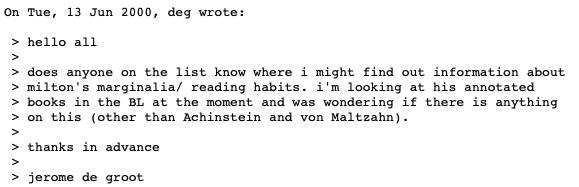
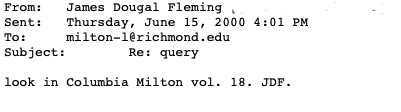
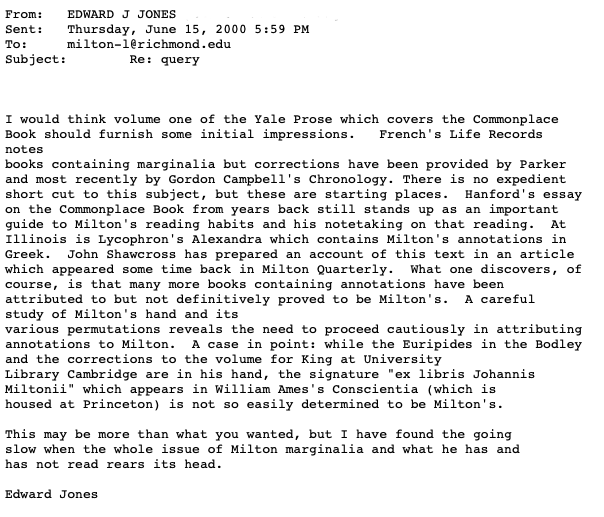
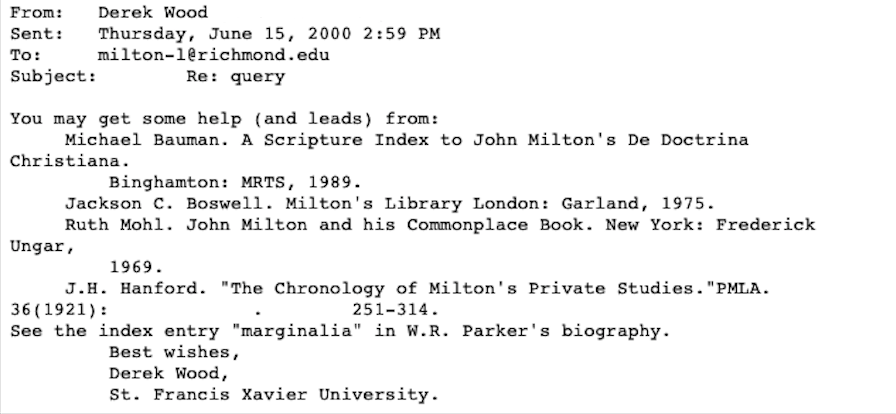
There are tantalising glimpses in secondary sources dating from the nineteenth century; while some of these need to be approached with caution, they are not to be entirely dismissed in every instance. It is very plausible, given Milton’s personal involvement in the Smectymnuans’ pamphlet debates with Joseph Hall, that his hand might be found in one of the many existing copies of the pamphlets arising from these disputes, as outlined in a late nineteenth-century Encyclopædia Britannica.[28] In an age of rapid digital communication, such searches have been instrumental in bringing together a community of Milton scholars worldwide; a Google search for the phrase ‘ex libris Johannis Miltonii’ brought up an intriguing conversation between Miltonists on the ‘Milton-L’ mailing list, which still exists on the servers of the University of Richmond in Virginia (see Figures 8a–d). But, in the continued quest ‘to be still searching what we know not, by what we know’ (Areopagitica, p. 30), it seems fitting to bring this blogpost to a close with an anecdote describing a potential Milton book in an antiquarian bookshop:
‘Once again, I [Madeleine Stern] believed I had found him at a bookshop in London’s St. John’s Wood during our annual buying trip. I quickly descended a ladder, a small calfbound volume in my hand, my eyes round with wonder, the book open to the title page. “Look at this!” I whispered dramatically to Leona [Rostenberg]. The sight that had stopped my breath was an ownership inscription inked on the margin of the title page: “Jn. Milton.” Could this, by the remotest possibility, have been a book touched, and read, and owned by John Milton? To us at the moment there was every likelihood that he had indeed written his name on the title page of Giovanni Marliani’s Vrbis Romae Topographia (Topography of the City of Rome). The book we held in our hands had been published in Venice in 1588 and was a guidebook, a kind of Baedeker, to the marvels of the Eternal City. It had been designed for the Roman tourist, and in the late 1630s Milton had been a tourist in Rome. What more likely than that he had purchased a guidebook during his visit and placed his name on its title page?’
Leona Rostenberg and Madeleine Stern sought out the opinion of Harris Francis Fletcher at the University of Illinois; following which, they were met with this response via a telephone call:
‘“This is Robert Downs, Director of the University of Illinois Libraries. […] It’s about that Milton signature […] Professor Fletcher wants me to tell you it’s an eighteenth-century forgery.”’[29]
fig. 8afig. 8bfig. 8cfig. 8d
THE AUTHOR
Hannah Yip is a Leverhulme Early Career Fellow at the University of Manchester.
APPENDIX: LIST OF LIBRARIES VISITED
Birmingham: Cadbury Research Library (University of Birmingham)
Durham: Durham Cathedral Library, Palace Green Library (Durham University)
London: British Library, Honourable Artillery Society Company, Inner Temple, Institute of Historical Research, Lambeth Palace Library, Middle Temple Library, National Art Library, Royal Society, Senate House Library, UCL Special Collections, Warburg Institute, Wellcome Collection
Manchester: Chetham’s Library, The John Rylands Library (University of Manchester)
Oxford: Christ Church, Magdalen College, The Queen’s College, Trinity College, University College
ACKNOWLEDGEMENT
I am grateful to Jason Scott-Warren, Claire M. L. Bourne, and Will Poole for their help with the copy of Ignatius of Antioch held at Durham. I also thank Jason and Claire for sharing their forthcoming Milton Quarterly article (‘“thy unvalued Booke”: John Milton’s Copy of the Shakespeare First Folio’) with me.
ENDNOTES
[1] See, for example, the output of William Poole, including William Poole, ‘‘The Armes of Studious Retirement’? Milton’s Scholarship, 1632–1641’, in Young Milton: The Emerging Author, 1620–1642, ed. by Edward Jones (Oxford: Oxford University Press, 2013), pp. 21–47;William Poole, ‘John Milton and Giovanni Boccaccio’s Vita di Dante’, Milton Quarterly, 48.3 (2014), 139–70; William Poole, ‘John Milton and the Beard-Hater: encounters with Julian the Apostate’, The Seventeenth Century, 31.2 (2016), 161–89; William Poole, ed., The Complete Works of John Milton, Volume XI: Manuscript Writings (Oxford: Oxford University Press, 2019). See also Edward Jones, ‘‘Filling in a Blank in the Canvas’: Milton, Horton, and the Kedermister Library’, The Review of English Studies, New Series, 53.209 (2002), 31–60. ‘Rediscovering the Lost Library of John Milton’ also seeks to revise the work undertaken by Jackson Campbell Boswell; see Jackson Campbell Boswell, Milton’s Library: A Catalogue of the Remains of John Milton’s Library and an Annotated Reconstruction of Milton’s Library and Ancillary Readings (New York, NY: Garland, 1975).
[2] See the subheading ‘Books from Milton’s Library’, CELM, <https://celm-ms.org.uk/authors/miltonjohn.html> [accessed 10 August 2022], although note that this list does not include William Poole’s 2014 discovery of Milton’s copy of Giovanni Boccaccio’s Vita di Dante Alighieri (Rome, 1544) (Bodleian Library, Arch. A f. 145) or the most recent discovery of Milton’s copy of Shakespeare’s First Folio by Jason Scott-Warren and Claire M. L. Bourne.
[3] See Poole, ed., The Complete Works of John Milton, Volume XI, p. 29.
[5] See Jason Scott-Warren and Claire M. L. Bourne, ‘“thy unvalued Booke”: John Milton’s Copy of the Shakespeare First Folio’, Milton Quarterly (forthcoming).
[6] Edward Jones questions whether one should use Milton’s commonplace book as the starting point for discovering Milton’s books, arguing that he may not have made notes on the texts if he already owned them. See Jones, ‘‘Filling in a Blank in the Canvas’’, p. 59.
[7] J. M., The Readie and Easie Way to Establish a Free Commonwealth, 2nd edn (London, 1660), p. 15. For An Inquisition after Blood (London, 1649), see Alastair Bellany and Thomas Cogswell, The Murder of King James I (New Haven, CT: Yale University Press, 2015), pp. 452–53; Poole, ed., The Complete Works of John Milton, Volume XI, p. 26 n. 53.
[8] See Poole, ed., The Complete Works of John Milton, Volume XI, p. 24 n. 44.
[9] See the ‘Primary Bibliography of Editions Used by Milton’, in Poole, ed., The Complete Works of John Milton, Volume XI, pp. 416–22.
[10] For example, William Laud owned one of the Lambeth copies of John Selden’s De jure naturali (London, 1640), Main Collection SR1 Quarto, [ZZ] 1640.33, while the Lambeth copy of Nicetas Choniates’ Historia (Paris, 1647), Main Collection GH, KF550.N5 [*], belonged to Gilbert Sheldon. Marginal annotations do not appear to have been documented on the University of Manchester online catalogue, meaning that there are some important omissions, such as an unidentified seventeenth-century reader writing in Italian in a tiny hand on their copy of Bernardino Daniello’s commentary on Dante (Dante Alighieri, [La Divine Commedia] con l’espositione di M. Bernardino Daniello da Lucca (Venice, 1568), The John Rylands Library, Walter L. Bullock Book Collection, 613).
[11] Poole, ‘John Milton and Giovanni Boccaccio’s Vita di Dante’.
[12] The USTC does not record the National Art Library’s copy of Paolo Giovio, Opera quotquot extant Omnia (Basel, 1578), 86.A.11. Similarly, the ESTC does not record the Institute of Historical Research Library’s copy of Robert Ward, Anima’dversions of Warre (London, 1639), IHR ONSITE STORE (S/W.6110/War), or UCL Special Collections’ copies of at least four texts which Milton consulted, including Paolo Sarpi, Historia del Concilio Tridentino (London, 1619), STRONG ROOM B QUARTO 1619 S1. See the Appendix for the full list of libraries visited over the eight-week period.
[13] Stephen B. Dobranksi, Milton, Authorship, and the Book Trade (Cambridge: Cambridge University Press, 1999), p. 208 n. 46.
[14] Jane Giscombe, ‘The use of pins in early modern England (1450–1700)’, The Book & Paper Gathering (31 May 2018), <https://thebookandpapergathering.org/2018/05/31/the-use-of-pins-in-early-modern-england-1450-1700/> [accessed 19 August 2022]; Adam Smyth, ‘Book Marks: Object Traces in Early Modern Books’, in Early Modern English Marginalia, ed. by Katherine Acheson (New York, NY: Routledge, 2019), pp. 51–69.
[15] Ignatius of Antioch, Quæ extant omnia (Geneva, 1623), Palace Green Library, Durham University, Routh 2.D.3.
[16] On the physicality of some of these books, see Nicholas McDowell, Poet of Revolution: The Making of John Milton (Princeton, NJ: Princeton University Press, 2020), p. 357.
[17] For example, Nicholas McDowell believes that ‘it seems unlikely Milton carried the five massive volumes of de Thou [Jacque-Auguste de Thou, Historiæ sui temporis (Geneva, 1620)]’ back from Geneva to Horton, although he concedes that he may have purchased these texts in London. Edward Jones questions whether Milton would have even wanted to own the more extended works relating to church history and the Church Fathers; see Jones, ‘‘Filling in a Blank in the Canvas’’, p. 45. Other evidence appears to argue in favour for his priorities in finding a place sizeable enough to ‘dispose his Books in’; see John Milton, Letters of State, Written by John Milton (London, 1694), p. xx; Poole, ‘‘The Armes of Studious Retirement’, p. 28; Poole, ed., The Complete Works of John Milton, Volume XI, pp. 28–29.
[18] Sharon Achinstein, ‘Did Milton Read Selden?’, in A Concise Companion to The Study of Manuscripts, Printed Books, and the Production of Early Modern Texts: A Festschrift for Gordon Campbell, ed. by Edward Jones (Malden, MA: Wiley-Blackwell, 2015), pp. 266–93 (p. 272). See also Jeffrey Alan Miller on Milton’s references to John Foxe in ‘Reconstructing Milton’s Lost Index theologicus: The Genesis and Usage of an Anti-Bellarmine, Theological Commonplace Book’, Milton Studies, 52 (2011), 187–219.
[19] For Milton’s reading versus book use, see Nicholas McDowell, ‘Reading Milton reading Shakespeare politically: what the identification of Milton’s First Folio does and does not tell us’, The Seventeenth Century, 36.4 (2021), 509–25.
[20] See the subheading ‘Exempla of Printed Works by Milton with his Inscriptions or Additions’, <https://celm-ms.org.uk/authors/miltonjohn.html> [accessed 12 August 2022]. Some of this information can be found in the ‘Bibliography’ drawn up by Gordon Campbell and Thomas N. Corns in John Milton: Life, Work, and Thought (Oxford: Oxford University Press, 2008), pp. 446–55.
[21] John Milton, Areopagitica (London, 1644), British Library, C.55.c.22.(9.) (formerly E.18.(9.)).
[22] For example, Barbara Kiefer Lewalski describes how Milton may have owned copies of the poetry of his friend Alexander Gil. See Barbara Kiefer Lewalski, The Life of John Milton: A Critical Biography, rev. edn (Malden, MA: Blackwell, 2003), p. 56.
[23] David Loewenstein, ‘“Casting Down Imaginations”: Milton as Iconoclast’, Criticism, 31.3 (1989), 253–70; Daniel Shore, ‘Why Milton Is Not an Iconoclast’, PMLA, 127.1 (2012), 22–37; Antoinina Bevan Zlatar, ‘Milton Among the Iconoclasts’, in Making Milton: Print, Authorship, Afterlives, ed. by Emma Depledge, John S. Garrison, and Marissa Nicosia (Oxford: Oxford University Press, 2021), pp. 123–40. For an argument that Milton was a Ramist, ‘deeply influenced by the logic and method of the visual form of the dichotomous table’, see Katherine Acheson, Visual Rhetoric and Early Modern English Literature (Farnham: Ashgate, 2013), ch. 2 (quotation from p. 52). The John Rylands Library’s copy of the Bernardino Daniello commentary on Dante (Walter L. Bullock Book Collection, 613) features an engraved frontispiece of the Seven Circles of Hell which has been annotated by the anonymous reader.
[24] Jason Scott-Warren, ‘Cut-and-Paste Bookmaking: The Private/Public Agency of Robert Nicolson’, in Early Modern English Marginalia, ed. by Katherine Acheson (New York, NY: Routledge, 2019), pp. 35–50.
[25] It is conjectured by William Poole that Milton may have owned either the 1632 or 1638 edition of John Guillim’s A display of heraldrie.Poole, ‘‘The Armes of Studious Retirement’’, p. 28; Poole, ed., The Complete Works of John Milton, Volume XI, p. 252 n. 374.
[26] Letter from John Milton to Peter Heimbach, Westminster, 8 November 1656. See John Milton, Joannis Miltonii Angli, Epistolarum Familiarium Liber Unus (London, 1674), pp. 48–49.
[27] See Gordon Campbell, ‘Milton, John (1608–1674)’, Oxford Dictionary of National Biography, online edn <https://doi.org/10.1093/ref:odnb/18800> [accessed 12 August 2022]. William Poole admitted that Milton’s music books were beyond the remit of his study; see Poole, ed., The Complete Works of John Milton, Volume XI, pp. 22–23, 30.
[28] The Encyclopædia Britannica. A Dictionary of Arts, Sciences, and General Literature, 9th edn (Philadelphia, PA: Maxwell Sommerville, 1894), Vol. 16, p. 341.
[29] Leona Rostenberg and Madeleine Stern, Old Books, Rare Friends: Two Literary Sleuths and Their Shared Passion (New York, NY: Doubleday, 1997), pp. 184–85.
LIST OF FIGURES
Figures 1a–b. William Rawley, Certaine Miscellany Works of The Right Honovrable, Francis Lo. Verulam (London, 1629), William Andrews Clark Memorial Library, University of California, Los Angeles, PR2207.9 .C51*, <https://calisphere.org/item/ark:/21198/n1p88q/> [accessed 10 August 2022]. Flyleaf and p. 26.
Figure 2. Milton’s brackets in his copy of Giovanni Della Casa, Rime et Prose (Venice, 1563), New York Public Library, *KB 1529. Photo: Micha Lazarus.
Figure 3. ‘Few MS. notes’; a British Library catalogue description for James Ware, ed., Two Histories of Ireland (Dublin, 1633).
Figures 4a–b. Ignatius of Antioch, Quæ extant omnia (Geneva, 1623), Palace Green Library, Durham University, Routh 2.D.3, pp. 225 and 252.
Figure 5. Milton’s annotations in his copy of Lycrophon, Lycrophonis Chalcidensis Alexandra (Geneva, 1601), University of Illinois Library, 881 L71601, p. 156.
Figure 6. Books at the British Library. Included in this image are Joannes Leo Africanus, Africæ descriptio IX lib. absoluta (trans. Joannes Florianus) (Leiden, 1632), 166.a.19. and 166.a.20. (16o); John Hardyng, The chronicle of Ihon Hardyng (London, 1543), 673.e.1., 673.e.2., and G.5938 (8o); Francesco Guicciardini, La Historia d’Italia ([Geneva], 1636), 592.c.7., two volumes (4o); Johannes Leunclavius, ed., Iuris Græco-Romani tam canonici quam civilis tomi duo (Frankfurt, 1596), 504.i.2., two volumes (2o); and Samuel Purchas, Purchas his pilgrimes (1625), 213.d.2-5., four volumes (2o).
Figure 7: Books at Chetham’s Library. Included in this image are Clement of Alexandria, Opera Græce et Latine, ed. by Fridericus Sylburgius(Paris, 1629), E.3.4 (2o); Georgius Codinus, De officiis magnæ ecclesiæ et aulæ Constantinopolitanæ (Paris, 1648), Gg.28.9 (2o); Hieronymus Commelinus, ed., Rerum Britannicarum (Heidelberg, 1587), U.4.34 (2o); Cyprian of Carthage, Opera, ed. by Simon Golartius ([Geneva], 1593), E.3.13 (2o); Dante Alighieri, [La Divine Commedia] con l’espositione di M. Bernardino Daniello da Lucca (Venice, 1568), Byrom 2.K.7.58 (4o); Paolo Giovio, Opera quotquot extant Omnia (Basel, 1578), U.9.26 (2o); John Hardyng, The chronicle of Ihon Hardyng (London, 1543), Radcliffe 2.F.4.38 (8o); Johannes Leunclavius, ed., Iuris Græco-Romani tam canonici quam civilis tomi duo (Frankfurt, 1596), N.4.28 (2o); Nicetas Choniates, Historia (Paris, 1647), Hh.7.8 (2o); Joannes Benedictus Sinibaldus, Geneanthropeia (Rome, 1642), Q.9.46 (2o).
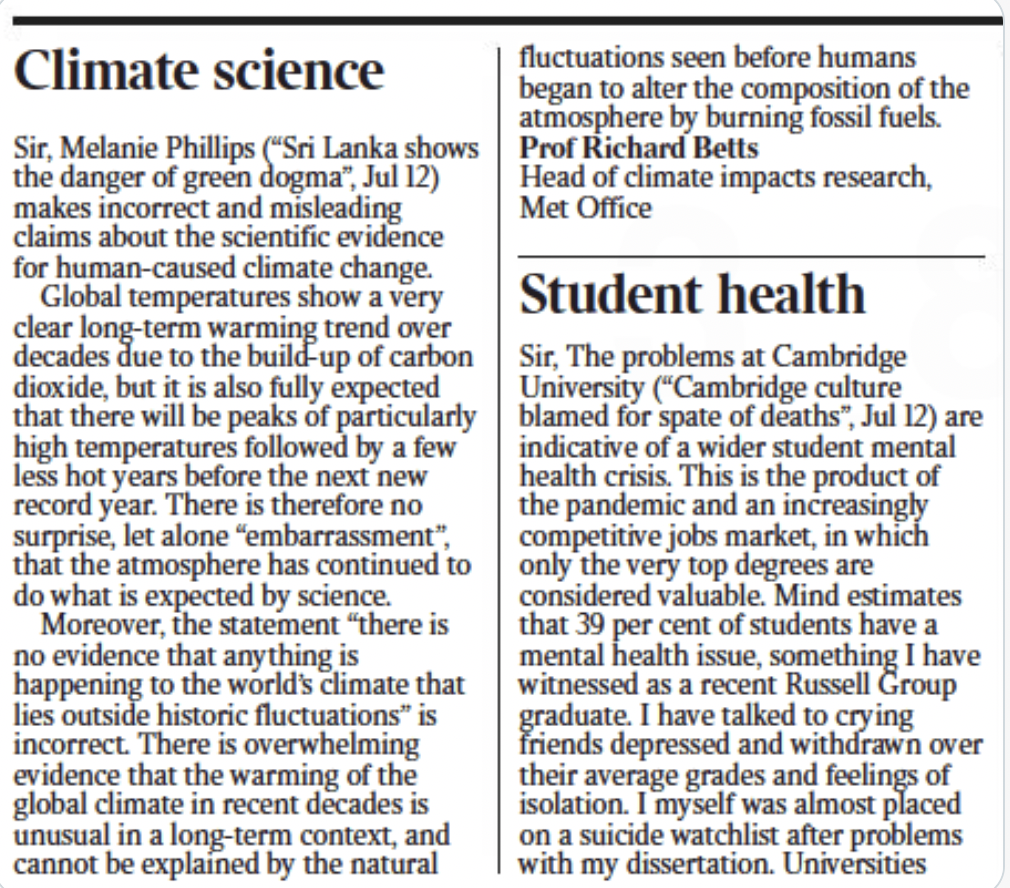
As the UK anticipates a heatwave that may well break existing records to the tune of 2, 3 or 4 degrees, this seems like an opportune moment to ask questions about the UK media, both print and broadcast, and how it is facilitating the destruction of our planetary life-support systems. A letter sent to The Times yesterday, by Professor Richard Betts, the Head of Climate Impacts Research at the Met Office, seems like a good enough place to start. The letter responds to an article by the commentator Melanie Phillips, in which she lambasted ‘an elite’s ideological fixation’ on apocalyptic climate change scenarios, stating that ‘There is no evidence that anything is happening to the world’s climate that lies outside historic fluctuations’. Betts’s letter stated, simply and straightforwardly, that she was wrong, her claims running counter to ‘overwhelming evidence’.
What is happening here? Phillips’ article was just an opinion piece, and people are usually thought to be entitled to their opinions, even where they are fairy tales. No apology or correction will be printed in relation to her misinformation, no complaint against it will be sustained, because it is just her opinion. Yet her opinion–in 930 words of doubtful logic, premised on transparent falsehoods–was printed in a newspaper that considers itself an organ of national record, with a circulation of 370,000 copies a day. It was not just an opinion; it was a broadcast to the nation which will be taken seriously by policymakers and politicians. Indeed, the article was clearly intended to influence the Conservative party leadership elections; it concluded by railing against ‘the Tories’ green believers’, those with the temerity to want to keep the net zero 2050 commitment.
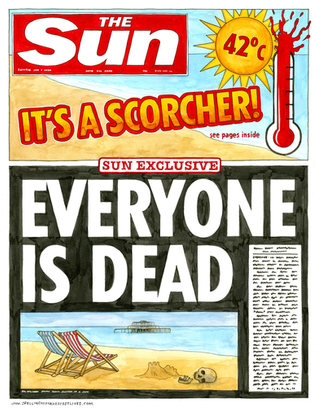
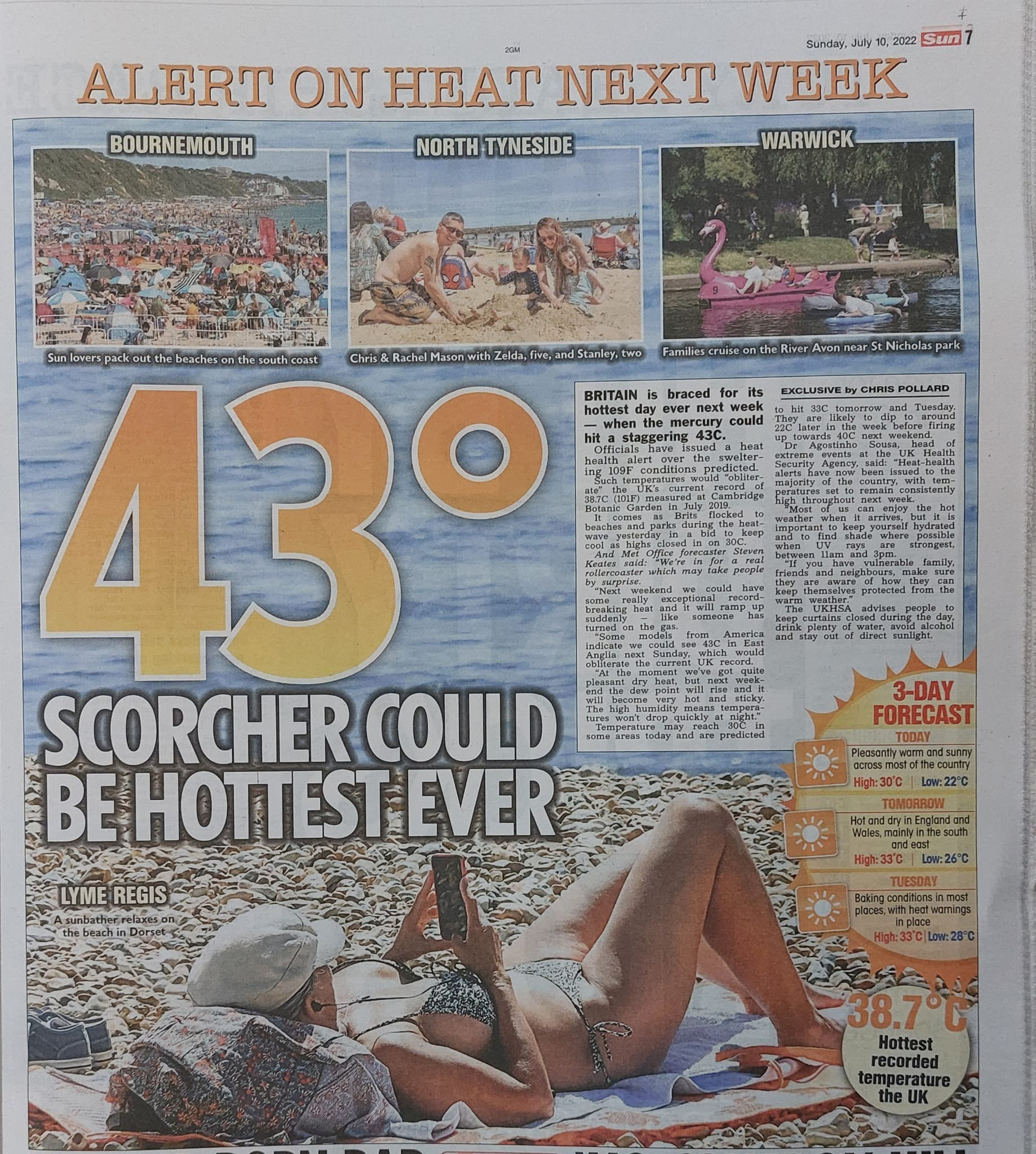
Phillips at least lays her cards on the table–in spite of overwhelming evidence, she doesn’t believe in the science. But her article is just one small part of a more disturbing picture, in which whole sections of the UK media have come out against radical action on climate collapse. Sometimes this is explicit, as in Phillips’s case, or in the comical scene that played out on GB News yesterday, when meteorologist John Hammond predicted that the coming heatwave would lead to hundreds and possibly thousands of premature deaths, and was contradicted by a news anchor who said she ‘want[ed] us to be happy about the weather’. Sometimes it is semi-explicit, as when three or four national newspapers (the Telegraph, the Express and the Sun among them) simultaneously came out in favour of fracking and ‘energy security’–meaning new oil and gas projects in the North Sea–after the Russian invasion of Ukraine. Sometimes, and perhaps more insidiously, it is silent, as when the BBC’s flagship radio news programme, Today, focuses on trivial stories and fails to cover floods, droughts and wildfires; or when it elects not to notice protests calling for action; or when it decides not to invite a politician to comment on stories relating to climate collapse.
That question again: what is happening here? The consumers of news media cannot see any of the decisions that are being made in boardrooms by the editors and deputy editors, and cannot feel the pressures coming from politicians or from billionaire media moguls. We cannot see how the profits from fossil fuels trickle down into the pockets of politicians and commentators, and how fossil fuel-funded lobbyists fan out across Westminster to reshape the big stories in forms that fit with their business models. (We know it’s happening, thanks to groups such as DeSmog, but usually we get to hear the details retrospectively, when the damage has been done). But these are the most material texts of our age. If we’re lucky enough to be able to look back, we’ll surely see each one as a nail in the intended coffin.
Great news yesterday that a large chunk of Mary Astell’s library has been discovered in the Old Library at Magdalene College, Cambridge, where it has undergone some expert analysis from the deputy librarian, Catherine Sutherland. Astell’s books are in some cases thickly annotated with her notes on contemporary scientific discoveries, and in others carry gift inscriptions that allow us to flesh out her circle of friends and colleagues.
Astell’s hand is wonderfully businesslike and serious as it sketches out the differences between Descartes and Democritus, or paraphrases details of the latest experiments in light and magnetism. I was particularly delighted by the explanation of why the bequest had disappeared from view, which was partly because scholars had been misdirected to Magdalen College, Oxford, rather than Magdalene College, Cambridge. Only in the nineteenth century was an ‘e’ added to the Cambridge name, to allow the two to be easily distinguished.
You can find the whole story, accompanied by wonderful images and commentary from several local luminaries, here.
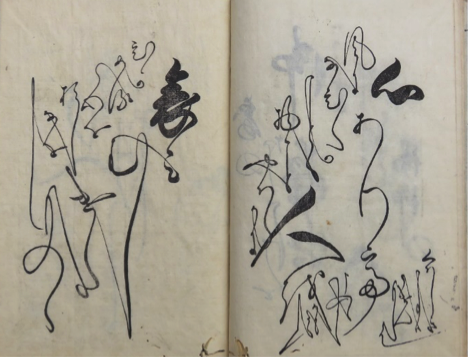
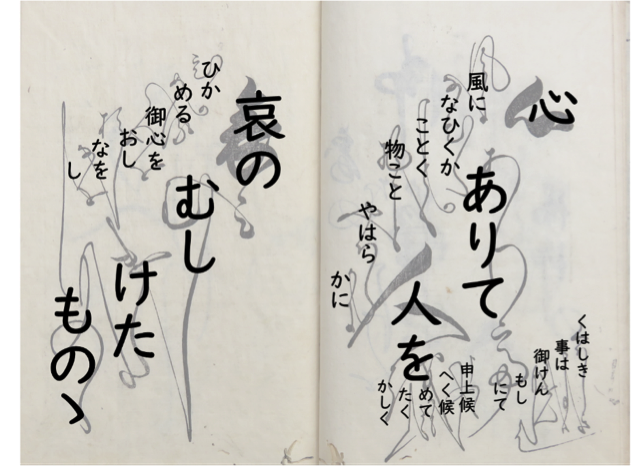
The first image in this blog post shows a page from a book published in 1713. In three volumes, it’s a collection of letters in the handwriting of a celebrity calligrapher called Hasegawa Myōtei. This page is part of a letter which, in heightened, literary language, advises someone to mend their bitter heart and be more like the willow tree which sways in the wind. The words vary between large and small, between thick rich lines and fine delicate ones; the forms are rounded and connected between letters and even between the vertical lines of text. The writing seems to drift downwards to the left, as if autumn leaves were falling in a gentle breeze.
This genre of publishing is called nyohitsu, the ‘woman’s brush’, and the books usually focus on letter-writing. The ‘woman’s brush’ extends to the style of writing which could also be used in commercial prose, and despite the name, it could be written by men as well as women. Nyohitsu was fashionable in the seventeenth and eighteenth centuries, with hundreds of books being published and republished, but it fell out of favour in the nineteenth century and is no longer practiced. Premodern Japanese script is almost completely illegible to most modern readers, so texts such as these that haven’t been considered important enough to transcribe are inaccessible to researchers, even when they are in the digital collections of libraries. In my research, my first challenge has been simply to learn to read them.
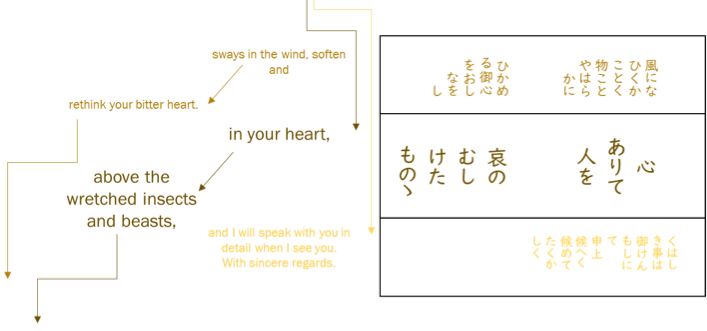
2 The large dark text is read first, following the arrows. The reader returns to the beginning and reads the second layer, in the mid colour. The reader returns to the beginning for the third layer, in yellow.
The next problem is the tension between what is on the page, and how I work with it. If I simply transcribe what I see page by page, it gives me fragments of phrases that don’t connect to each other, because the letter extends across the pages before and after in ways that we don’t expect and I can’t easily represent. Image 2 shows how I experimented with colour coding and arrows to follow how the reader moves backwards and forwards through the pages of the book. But while this helps illustrate how to interact with the text, it is unhelpful for a close reading of what the text actually says. For that, I still need to turn it into a readable, searchable, copy-and-pasteable typographic transcription.
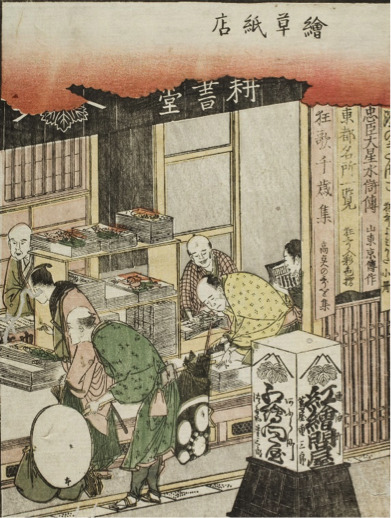
This process of typographic transcription is an ongoing project for scholars of premodern Japan, but we shouldn’t make the same mistake that early western visitors to Japan did. Early modern Japan had a vibrant and mature publishing industry catering to many different markets, including the women who were buying nyohitsu manuals or borrowing them from libraries. The third image shows a bustling shop full of customers browsing the illustrated books. However western visitors didn’t recognise this highly developed print culture, because Japanese books were floppy, stored on their sides, and they were woodblock-printed. We need to remember that woodblock printing was not a technological limitation, and moveable type was not a technological advance. Ceramic and wooden moveable type had been invented in China in 1040, and metal moveable type in Korea in 1250 a full two hundred years before Gutenberg in 1450. Moveable type was broadly unsuited for most applications of the character script shared by China, Japan, Korea and Vietnam, and woodblocks had advantages such as flexibility in combining text and image, and as the first image of the nyohitsu book shows, the ability to showcase the aesthetics of handwriting itself.
3 A book shop. Circa 1802, Katsushika Hokusai.Joan Elizabeth Tanney Bequest, LACMA
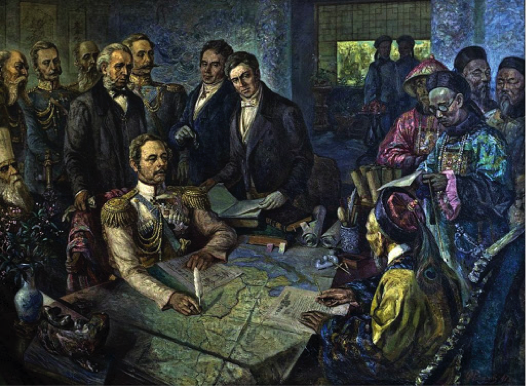
The shift from xylography to typography didn’t occur until the late nineteenth century, a period of huge change. The western powers had turned their attention to East Asia seeking new markets, and had shown they were willing to use force to get it. China’s ‘century of humiliation’ had already started with the loss of Hong Kong to Britain, and image 4 shows a treaty after their defeat by Russia. To avoid a similar fate, Japan urgently needed to be “modern” and “western”, and in the course of a few decades, Japan reorganised and revolutionised. This is the context for the shift to typography: all of the previous advantages of woodblock printing were now outweighed by the other imperatives.
4 Treaty of Aigun. c. 1858 Vasily Romanov. N.I. Grodekov Khabarovsk Territorial Museum
Nyohitsu’s nineteenth-century disappearance is likely to be a complex picture, but its incompatibility with typography is clearly implicated. Japanese script had to fit the demands of moveable type: the numbers of letterforms were cut down, variation was eliminated and letters were disconnected from each other. Typography aims for repeatability, as well as transparency: we shouldn’t be distracted from the content of writing by how it looks. We understand of course that if we change fonts we get different effects, but the message remains the same. What we see with nyohitsu is different. It might look like a font, but acts like a linguistic register. What it looks like contains important information, telling us something about the writer, the reader, and the relationship between them, as well as what kind of situation the interaction is happening in. Nyohitsu expressed affective qualities like warmth, friendliness, and intimacy. The manuals contained letters that said things along the lines of “As the autumn blows a cool breeze, the sky is bright and clear. I send my greetings on the festival of Tanabata.” This is not interesting for its content, but for the material expression of a relational gesture. In nyohitsu script, this could express friendly affection. The same message in a different script might be impersonal, frosty, or deferential. Using nyohitsu script to the wrong person could be over-familiar or disrespectful. The extravagant letterforms and elaborate page layouts are not decorative, but integral to the meaning. The final image is of something that looks like a nyohitsu page, but it has been stripped of meaning. As Marshall McLuhan’s famous aphorism goes, “the medium is the message”.
5 Something that looks like f.12v-13r of Hasegawa Myōtei’s 1713 Sasareishi, but is not.
Nyohitsu resists typographic transcription because it has more to say than the limitations of typography will allow. Nevertheless, I continue to transcribe. Not only because modern literacy is typographic, but because, as McLuhan was pointing out half a century ago, we have built a world conditioned by typography – email, databases, WhatsApp, OCR, kindles, pdfs and the rest. As late nineteenth-century Japan realised, more than a medium, typography is a knowledge regime: only that which can be contained in typography counts as academic knowledge. That which that cannot be transcribed is not data. So I continue to transcribe, stripping nyohitsu of its meaning by repeating the process that led to its extinction in the first place. We are in an exciting moment when digital technologies like machine-reading and AI are allowing access to distant archives and research methods like distant reading, data-mining and corpus analysis. But at the same time, if we allow our digital future to be limited by typography, we are re-enacting what happened to nyohitsu: a new digital colonialism.
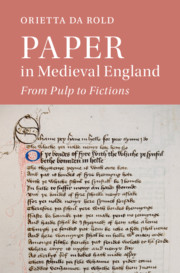
Congratulations to Orietta da Rold, whose book Paper in Medieval England: From Pulp to Fictions has recently appeared from Cambridge University Press. The book offers the first detailed reassessment of the arrival and early use of paper in England, and explores the ways that it was used by people across medieval society, from kings to merchants, to bishops, clerks and poets.
For more on the history of paper, see the report of our 2018 conference here.
During the Covid lockdown, the London Review of Books has been exploring its back-catalogue, and sending out choice articles to cheer its subscribers up. Today I had my day interrupted by an article on the way that social media interrupts our day–Rebecca Solnit’s ‘In the Day of the Postman‘.
It’s a rueful meditation on the simplicity of the lives we used to lead, written by someone whose life has straddled the digital divide. As another straddler, I don’t find it all easy to make moral judgments about the before and after–life before was, as I recall, often quite boring, while life after seems to involve too many people playing Candy Crush or watching James Bond on their phones. But Solnit analyses it very well, and her proposal that we need to work to put the world back together again–to regain a local, meaningful, slow and honest relationship to our experience–resonates. Will I be deleting Facebook and Twitter? Soon, I promise, but not just yet…
One of the stranger consequences of the coronavirus lockdown has been a growing fascination with the contents of the bookshelves that are suddenly visible in the backgrounds of politicians and pundits forced to Skype or Zoom or Facetime in to deliver their wisdom to the nation. Such bookshelves have long been a matter of passing interest for the way that they help to shore up the authority of the speaker, and for the occasional revelations they offer about the intellectual coordinates of a politician’s life. But now they have become unavoidable.
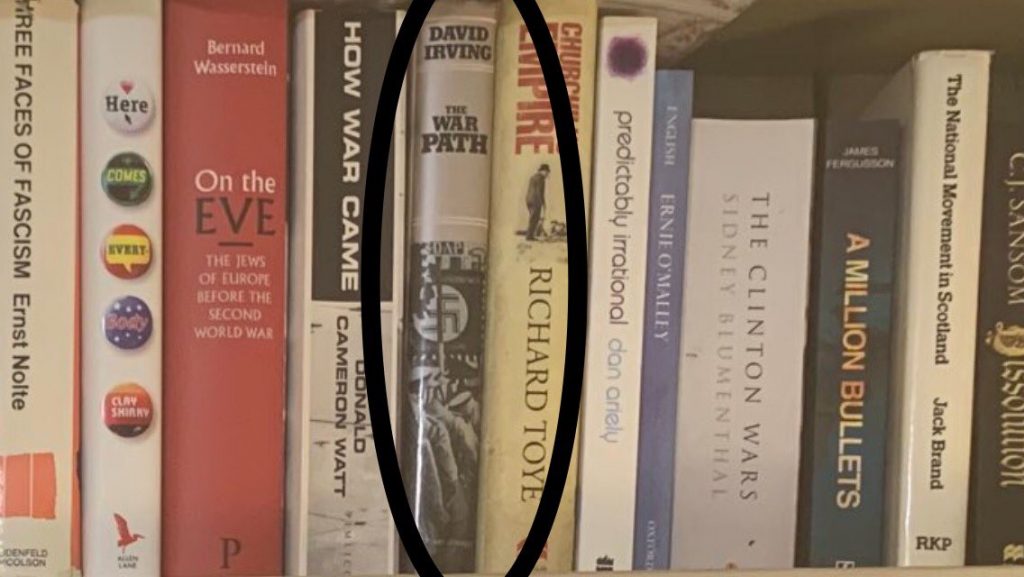
Yesterday we were briefly transfixed by the “shelfies” of the conservative politician Michael Gove and the Daily Mail commentator Sarah Vine, in which the eagle-eyed spotted copies of The War Path, by the Holocaust denier David Irving; Herrnstein and Murray’s The Bell Curve, which argues that intelligence is unequally distributed by race; and Ayn Rand’s right-wing novel Atlas Shrugged. Many commentators noted that owning a book doesn’t mean that you agree with its contents, while others remarked on the general lack of female writers among Gove’s heavyweights, or wondered what the response would have been had Jeremy Corbyn (repeatedly accused of antisemitism during his time as leader of the Labour party) been found to have holocaust deniers on his shelves. Last night, BBC’s Newsnight ran a feature in which they showed politicians in front of their bookshelves, and gender was again at issue: we’re sorry for the preponderance of men, Emily Maitliss told us, but that was because it’s men who tend to sit in front of bookshelves for their interviews. And a Twitter account called ‘Bookcase Credibility’, which circulates pictures of egregious shelf-parading, is trending.
All of this was of course just the usual storm in a social media teacup, which will soon blow over and leave us exactly where we were before. But it has a particular resonance for those of us who work on the history of libraries, or for people like me who just find themselves unable to take their eyes off other people’s bookshelves. My recent book, Shakespeare’s First Reader, grew out of the fits of nosiness that sweep over me when I visit a friend’s house and see their shelves, tranposed to the sixteenth century. What are all these books? Where did they come from? Have they been read? How have they shaped the life, the experience, the identity of the person I thought I knew?
Part of the fascination is, of course, not just in the individual items but also in their disposition—neatly organised or heaped-up and messy? well thumbed or pristine?—and the relationship between the books and the rest of the room, with its multiple markers of taste, wealth and interest. The material details are so telling, though often in ways that are hard to formulate: we just react to them with a shiver or a feeling of warmth. But beyond that, the sight of a bookshelf sets up an oscillation: it lets you in and screens you out; holds out the books but keeps them firmly closed; shows you ‘reading’ whilst asserting that you could never see something as intimate and secretive as reading. All of this explains why I’ll be keeping more than half an eye, with a twinge of guilt, on that twitterstorm.